


US Corn and Soybean Yields Unlikely to Climb Heading Into Harvest
U.S. corn and soybean yields are unlikely to climb above early August forecasts as another month of uneven weather impacts crops across the Corn Belt.



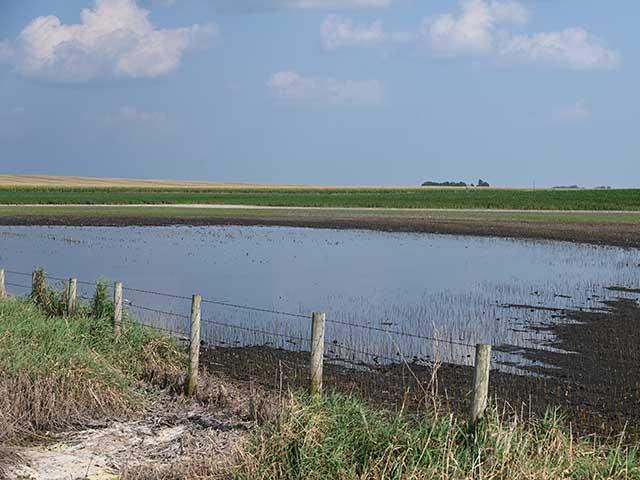
Heavy August rains in central Iowa left large drowned-out areas in fields, including this one near Ankeny, resulting in significant yield losses. (DTN photo by Matthew Wilde)
ANKENY, Iowa (DTN) — The DTN Digital Yield Tour and USDA in early August projected average U.S. corn and soybean yields below last year’s record levels. After another month of uneven weather across much of the Corn Belt, those forecasts are unlikely to move higher.
Based on DTN’s models as of Aug. 1, the national average corn yield is projected at 178.5 bushels per acre (bpa) and soybeans at 52.1 bpa. The August USDA World Agricultural Supply and Demand Estimates (WASDE) report pegs national corn and soybean yields at 180.7 bpa and 52.7 bpa, respectively.
Mark Licht, Iowa State University Extension cropping systems specialist, said corn and soybean yields won’t hit all-time highs like last year at 186.5 bpa and 53 bpa, respectively. In fact, he thinks both may regress a little from early August projections.
“The cumulative stress across the growing season is starting to show up in the crop condition,” he added. “I don’t foresee USDA’s yield estimate increasing by any means. They will likely stay similar or drop a bit.”
VARIABLE WEATHER AFFECTS YIELDS
Growing conditions haven’t been bad this season, but they haven’t been ideal.
According to the National Drought Monitor, drought conditions remained stable or expanded in much of the Upper Midwest in August. Severe drought (D3) expanded across northwestern Wisconsin and into eastern Minnesota. In the central Corn Belt, heavy, widespread rains were common last month, accompanied by strong winds in some areas.
National corn and soybean condition ratings have generally deteriorated during August, according to USDA NASS’s weekly Crop Progress report. On Aug. 2, 61% of corn was rated in good-to-excellent condition compared to 57% on Aug. 30. The U.S. soybean crop was rated 63% good to excellent on Aug. 2 compared to 58% on Aug. 30.
“I think the top end of yields were already taken off in June and July with all the rain and heat, and the rain in August didn’t help the soybeans like it normally would since there was already plenty of soil moisture (in the central Midwest). We’re starting to see some nitrogen deficiencies in corn and sudden death syndrome in soybeans,” Licht said. “The bright spot is we didn’t have the foliar disease pressure on corn and soybeans like the past two years, and August rains did help areas suffering from drought.”
WEATHER AND CROP OUTLOOK
After a stormy start to August that delivered severe weather across much of the central Corn Belt, including historic flooding in Indiana, DTN Ag Meteorologist John Baranick said another active weather pattern could develop in the region during September. More rain is forecast in the northern Corn Belt, which could help crops.
“There’s still time for immature crops in the Dakotas and other dry northern areas to develop further and possibly increase yields, as the weather pattern is turning wetter,” Baranick said.
Meanwhile, the South and Plains are expected to remain hot and dry early this month.
A ridge over the West and Plains is responsible for recent extreme heat across the southwestern quadrant of the country that has extended into Oklahoma and Texas where daily 100-degree readings have been common. That pattern is expected to continue in the near term across the southern tier of the country and spread through the Southeast. The ridge could extend into the Midwest and Northeast for a period as well.
“We might have some issues where we end up with some flooding across northern portions of the Corn Belt, and the South will stay hot and dry,” Baranick said. “But, in general, this active September pattern (in the north) should turn drier.”
DTN will be releasing updated yield estimates ahead of the Sept. 11 WASDE report.
Here are Results From the 2026 DTN Digital Yield Tour: https://www.dtnpf.com/agriculture/web/ag/crops/article/2026/08/10/results-2026-dtn-digital-yield-tour
August USDA WASDE report: https://www.usda.gov/about-usda/general-information/staff-offices/office-chief-economist/commodity-markets/wasde-report
Check out the current Drought Monitor map here: https://droughtmonitor.unl.edu/
And for DTN’s forecast for early September, see https://www.dtnpf.com/agriculture/web/ag/blogs/ag-weather-forum/blog-post/2026/08/26/another-ring-fire-weather-pattern.
Matthew Wilde can be reached at matt.wilde@dtn.com
Follow him on social media platform X @wildeagwriter
(c) Copyright 2026 DTN, LLC. All rights reserved.