


Iowa Cattle Conservation Program Expands Due to Overwhelming Demand
Iowa's Cattle and Conservation Working Lands Program, expanding to include a total of 28 counties, quickly exhausted its $1.5 million budget in 10 days, prompting an additional $2.1 million allocation to meet overwhelming producer demand.


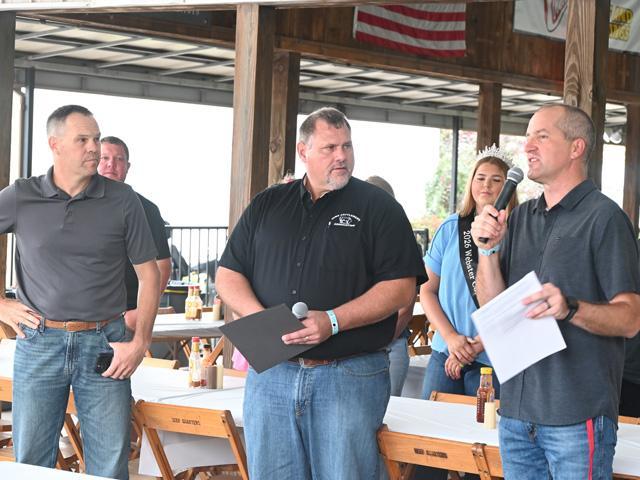
Greene County, Iowa, cattleman Bill Fields, left, and Iowa Cattlemen’s Association CEO Bryan Whaley, center, were part of the announcement at the Iowa State Fair on Aug. 18 by Iowa Secretary of Agriculture Mike Naig, right, for a conservation program to convert cropland to pasture and hay ground. (DTN/Progressive Farmer photo by Jennifer Carrico)
REDFIELD, Iowa (DTN) — The Cattle and Conservation Working Lands Program was just introduced in August for 28 counties in Iowa, and additional funding has been allocated due to the overwhelming demand for the program.
On Aug. 18, Iowa Secretary of Agriculture Mike Naig announced the next phase of the Greater Des Moines Watershed Program, which is targeted to scale up the use of conservation practices in the upper part of the watershed to improve water quality downstream.
“We want to make sure water quality is top of mind. Clean water is non-negotiable from farm to faucet,” said Naig during a press conference at the Iowa State Fair.
On Sept. 2 at the Farm Progress Show in Boone, Iowa, Naig revealed additional funding for the program because the previous funding of $1.5 million had been obligated to Iowa livestock producers within 10 days of the original announcement. The additional $2.1 million has been allocated by the Iowa Department of Agriculture and Land Stewardship (IDALS) through the end of the calendar year.
HOW THE PROGRAM WORKS
The Cattle and Conservation Working Lands Program provides a cost-share to help cattle producers convert underperforming or highly erodible acres into pasture or hay ground. Naig noted this would provide land and forage to support the growth of the U.S. beef herd, while reducing soil erosion and improving water quality. Cropped acres converted to hay for a five-year commitment would pay $290 per acre in a one-time payment. Cropland converted to pasture would pay $1,000 per acre in a one-time payment.
“The Cattle and Conservation Working Lands Program is truly a win-win, balancing productivity while improving Iowa’s water quality and soil health,” Naig said. “By converting underperforming cropland into grazing land for cattle and other livestock, we can put every acre to its best use and keep working lands working. It creates opportunities for young and beginning farmers, generates new revenue for landowners and makes more land available to grow the cattle herd. Based on the program’s success in Iowa, I would like to see it become a model for reforming the federal CRP program.”
Naig said that based on the success of the program, he could ask the Iowa Legislature for additional funding in 2027 to expand the Working Lands Program statewide.
INDUSTRY AND FARMERS WORK TOGETHER
Iowa Cattlemen’s Association CEO Bryan Whaley said that while Iowa has the infrastructure to expand the cattle herd, more grazing opportunities are needed.
“We are grateful to the Iowa Department of Agriculture and Land Stewardship for the expansion of the Iowa Cattle and Conservation Working Lands Program,” he said. “Iowa’s cattle producers know they are an important part of providing clean water for everyone in our state. This is about building on the good work already happening on Iowa farms and giving producers the tools and support to do even more to improve our land and water.”
Greene County, Iowa, cattleman Bill Fields said he looks forward to using the program since his county is in the allocated area.
“This will allow many of us to expand our herds because we will have additional pasture and hay available,” he said. “We have always used cattle as a conservation tool, and this allows us to have more opportunities to continue.”
Naig said the eagerness of farmers to be part of this type of conservation program shows the commitment they have to improving water quality.
“It reinforces that farmers are eager to embrace responsible farming practices to protect their land for future generations, and they want to be part of the ongoing work to improve Iowa’s water quality,” he said.
FROM PILOT TO LARGER PROGRAM
The program started as a pilot project in Taylor County in 2016, then expanded to include Adams, Carroll, Cherokee, Guthrie, Ida, Page and Woodbury counties. After the Farm to Faucet funding passed during the 2026 legislative session, it is expanding to Audubon, Boone, Buena Vista, Calhoun, Clay, Dallas, Dickinson, Emmet, Greene, Hamilton, Hancock, Humboldt, Kossuth, Palo Alto, Pocahontas, Polk, Sac, Webster, Winnebago and Wright counties.
To date, IDALS has six project coordinators who have helped enroll more than 1,100 producers in the program. More than 16,000 acres of less-productive agricultural land have been converted from row crops to pasture and hay. Participating producers have also established more than 195,000 acres of cover crops, which help prevent soil erosion, filter nitrates and provide forage for livestock.
Farmers and landowners can continue to sign up for the program through Sept. 9 at 4:30 p.m. CDT at their local USDA Service Center.
Jennifer Carrico can be reached at jennifer.carrico@dtn.com
Follow her on social platform X @JennCattleGal
(c) Copyright 2026 DTN, LLC. All rights reserved.