


USDA Staffing Shortages Strain FSA and NRCS Services Across Rural America
Workforce reductions and hiring restrictions at USDA's Farm Service Agency and Natural Resources Conservation Service are leaving local offices understaffed, reducing services and stretching remaining employees thin.



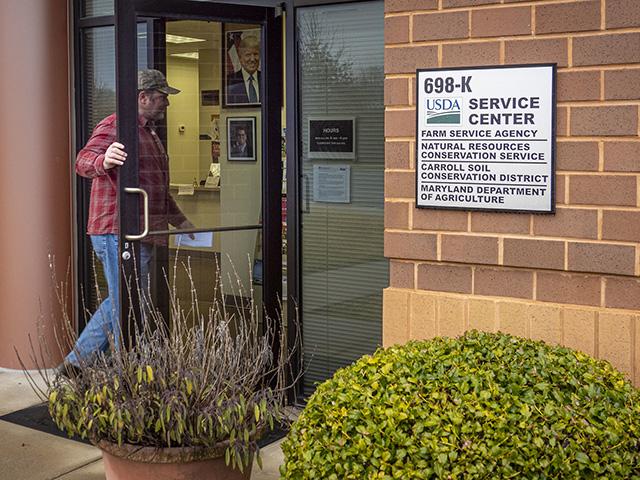
A producer walks into a USDA Service Center. FSA offices remain open on paper, as required by law, but staffing has been shifted and offices fragmented. It’s a new model for FSA and NRCS: doing more with less under federal workforce reduction directives, while USDA’s reorganization also shifts work and modernizes paperwork. (Photo courtesy of USDA)
WASHINGTON (DTN) -- Farmers in Polk County, Iowa, still have a Farm Service Agency office to visit. But when they arrive, four out of five days, that office will be closed.
Calls are rerouted and employees from other counties come in to staff the office. Typically, Aaron Lehman brings his maps to the office to certify his planting date for crop insurance eligibility.
"Farmers in my neighborhood are just used to walking into the office and quickly talking through it, saying, 'Remember that field, we did this last year,'" Lehman said. Without his local office and FSA staff, "the familiarity of people with the farmers is much different."
The changes in Iowa are part of a broader shift underway at the U.S. Department of Agriculture, where FSA and the Natural Resources Conservation Service (NRCS) are trying to maintain local services with a smaller workforce.
The 2025 reduction in force, initiated under the Department of Government Efficiency (DOGE), offered buyouts through the Deferred Resignation Program (DRP) and terminated probationary employees, eliminating thousands of positions across the two agencies. That included roughly 795 FSA employees and 2,657 NRCS employees, along with an 8% reduction in local FSA staffing, or 1,082 employees, in 2025.
In June, the agency attributed staffing shortages to employees who accepted early retirement offers under the administration and said it lacked a large enough budget to rehire workers. That comes despite USDA requesting a fiscal year 2027 budget that is $50 million less for NRCS and $19 million less for FSA than the previous year.
For NRCS, the 2027 budget calls for 6,009 full-time equivalent (FTE) positions, a reduction of more than 25% from two years earlier.
See "USDA Works on FSA, NRCS Restaffing Plan" here: https://www.dtnpf.com/agriculture/web/ag/news/business-inputs/article/2026/06/26/usda-blames-closed-offices-departed.
It's also happening soon for his neighbors in Poweshiek County. In July, FSA clients received a letter in the mail saying that their office would be open by appointment only, once a week. They were also asked to choose another office to which they could send their files by Sept. 1 because of "limited staffing resources" and nationwide budget constraints.
Top USDA leadership has acknowledged an "imbalance between the work and the workforce." In a recent interview with DTN, Deputy Secretary Stephen Vaden said NRCS has a map identifying staffing shortages and that the agency is "working to even it out."
The agency told DTN it plans to hire 272 NRCS employees this year, leaving it 346 short of its 9,500-employee goal. As of June 2026, the Office of Personnel Management (OPM) data shows NRCS had 8,882 employees -- well below its 2020-25 average of 10,698.
But what that means locally remains unclear.
"That's the frustrating part," said Lehman, who is also the president of the Iowa Farmers Union. "I don't know the answer to why we're not getting the answer about where we are at with our USDA staff."
FSA offices remain open on paper, as required by law, but staffing has been shifted and offices fragmented. It's a new model for FSA and NRCS: doing more with less under federal workforce reduction directives, while USDA's reorganization also shifts work and modernizes paperwork.
ONE EMPLOYEE, THREE COUNTIES
Across the border, in Polk County, Minnesota, one NRCS employee is drawing up conservation plans for three counties and answering calls and emails from as early as 7 a.m. to as late as 7 p.m., farmer Craig LaPlante said.
He knows because he answers those calls and depends on those plans.
LaPlante farms 700 acres of soybeans, wheat and winter camelina near Crookston. He is implementing rotational grazing, fencing and water storage through the Environmental Quality Incentives Program (EQIP) but said he is nearing 2.5 years in the planning process.
His approved EQIP payments have been on their way from the Treasury Department for a month. Payments that once arrived almost immediately have taken months, he said. The delay is becoming a financial cost: LaPlante expects to soon pay 8% interest on loans while waiting for NRCS payments.
The strain extends across the county, which is 96 miles wide and heavily agricultural. Farmer Gabe Arveson, 23, said the Polk County has FSA coverage on either side of the county but just one NRCS employee.
"The staff are so overwhelmed," Arveson said. "Everyone is starting to get frustrated because we have nowhere to go."
Polk County's NRCS office is also helping cover neighboring Red Lake County because of staffing shortages.
"Sharing personnel between two counties ... is delaying our packages, it's delaying payments," LaPlante said. "How are they going to be able to implement these EQIP programs?"
Understanding the realities of conservation work, Arveson said, "At the end of the day, you're working with the federal government."
USDA said it is identifying staffing gaps and moving employees toward areas with the greatest workloads. The agency told DTN it has reassigned staff to ensure coverage for all counties, adding that a flexible workforce, partners and technical service providers are essential to helping farmers.
According to an analysis by Prospect Partners LLC, more than 1,300 counties experienced a net reduction in headcount in 2025. In 144 counties, NRCS lost 100% of its staff by year's end.
Not every county needs the same level of FSA or NRCS staffing or requires staff at all. But when farmers can no longer access FSA for core functions, such as maintaining acreage records or NRCS for technical conservation assistance, problems begin to take root.
In Kaplan, Louisiana, the strain is also falling on soil and water conservation districts and the institutional knowledge they share with NRCS.
Christian Richard, a rice, crawfish and soybean farmer in one of the state's highest-workload NRCS areas, serves on his local conservation district board and is a member of the American Farmers for Conservation. He calls the districts a "springboard" for NRCS but said employees are now covering more ground.
His parish is fully staffed but lost institutional knowledge has made it harder for employees to understand Southern Louisiana's unique crop rotations.
"The better a NRCS employee is at something, the more work they do," he said.
THE OFFICE THAT IS STILL OPEN
Farm Operations
DTN’s data science helps our members make important fields and grain marketing decisions. Learn more about our membership plans.



In southeast Wisconsin, farmers slide paperwork under the door or leave it with the NRCS office. If questions arise during review, staff and producers play phone tag.
Because of a hiring freeze following two early retirements, the West Bend, Wisconsin, office has cut Mondays and Fridays, allowing employees to travel to other offices. Staff travel to the town of Juneau on other days, with office hours running roughly from 11 a.m. to 6 p.m.
A shared management team covers two offices and three counties, once staffed by 11 employees and now down to six.
DTN has received reports of farmers driving about 45 minutes to the neighboring Juneau office to receive USDA services in person.
John Falk, a dairy farmer and Washington County Farm Bureau president, said farmers want to preserve local offices rather than see services move entirely online or be consolidated in a state office.
"We want to keep the local offices open rather than going to a fully online thing or it all being directed through like one state's office," Falk said. "We do want to keep the local offices open and do that as much as possible."
According to OPM data, federal agencies lost 795 employees in 2025 but added 123 more than they lost since June 2026.
Matt Russell, former Iowa FSA director, told DTN the staffing problem is likely compounded by FSA's full-time equivalent (FTE) ceiling, which caps how many employees each state is authorized to have. When attrition and hiring restrictions push staffing below that ceiling -- and the ceiling itself is lowered -- vacancies can accumulate before FSA is able to replace them, reducing service even when offices remain open. He now serves as the executive director of the Iowa Farmers Union.
Congress criticized this changing USDA budget model in June during a USDA oversight hearing.
WHEN THERE IS NO ONE LEFT
But for some farmers, the problem is not simply getting into the office. It is waiting for the employee responsible for getting the work done.
In western Kansas, home to some of the state's highest Conservation Reserve Program and Conservation Stewardship Program workloads, several NRCS offices have one or fewer employees.
As of mid-July, Cheyenne and Thomas counties had no NRCS staff. Sherman County had only a range specialist, Rawlins County had a soil conservation technician and Wallace County had a district conservationist. Decatur County had no technical service providers available to help with the conservation workload.
In a statement to DTN, USDA said, "All offices have NRCS coverage and producers should contact their local service center and schedule an appointment."
But the agency also said that if producers cannot reach their local office, they should contact their state conservationist -- leaving producers unsure how the agency defines "coverage" in 2026.
A Kansas soil and water conservation volunteer and farmer told DTN that state USDA leadership has indicated local officials will have greater authority to increase staffing but has not provided a timeline.
The farmer, who declined to speak on the record, said, "We can ask and say we're short (staff), but we can't come out and say much because of all the issues and stuff that happens when you start doing that."
Speaking out puts a target on conservation groups who don't want President Donald Trump to notice, for fear of additional cuts.
Still, every farmer interviewed for this story praised the professionalism and assistance of USDA employees, even as they described the challenges created by understaffing.
A current county FSA employee in an affected county, speaking on the condition of anonymity because of concerns about federal retaliation, said the reductions affect their relationship with farmers. "I love my job," the employee said. "And I love the connections I have made with our producers. I have seen them at their best and at their worst over the years."
But with reduced hours alone, "It limits when our producers can come to the office and many have told us they will not drive to another office to do their business," the employee said.
While USDA offered many public feedback opportunities -- reducing local staff was not one of them.
Sen. Josh Hawley, R-Mo., sent a letter to USDA on July 7 requesting a list of counties the agency wishes to close. USDA told DTN the response would be directed to his office and would not be publicly disclosed to Missouri residents and producers.
American Farm Bureau Federation conservation lobbyist Courtney Briggs told DTN that farmers are "totally bought in" on conservation, but without enough technical service providers, "we're going to be in a really tough situation."
AFBF, along 100 other organizations, sent a letter to congressional appropriators expressing concern about the staffing shortages. With USDA reducing its budget and FTE allocations, the issue could ultimately fall to Congress to provide more funding to address the gaps.
"We just need bodies and offices, and we need expertise to help us get these projects off the ground," the Briggs said.
-- Sen. Josh Hawley Letter: https://www.hawley.senate.gov/hawley-urges-secretary-rollins-to-keep-farm-service-agency-offices-open-in-missouri/
-- Prospect Partners LLC Staff Reduction Data: https://prospectdc.com/2026/03/27/cuts-to-usda-conservation-staff-removed-local-expertise-in-agricultural-communities-nationwide/
-- Also see, "USDA Budget Proposal Signals Shift Away from Food Aid, Rural Development" here: https://www.dtnpf.com/agriculture/web/ag/blogs/ag-policy-blog/blog-post/2026/04/04/usda-budget-proposal-signals-shift.
Jake Zajkowski can be reached at jake.zajkowski@dtn.com
Follow him on social platform X @jzajkow
(c) Copyright 2026 DTN, LLC. All rights reserved.