


House Passes Funding Bill as Republicans Pressure Trump on Beef Imports
The House on Tuesday passed the Senate's continuing resolution to fund the government through Dec. 11, while Republican lawmakers prepare to take ranchers' concerns over the Trump administration's beef agenda directly to the White House as new beef imports begin.



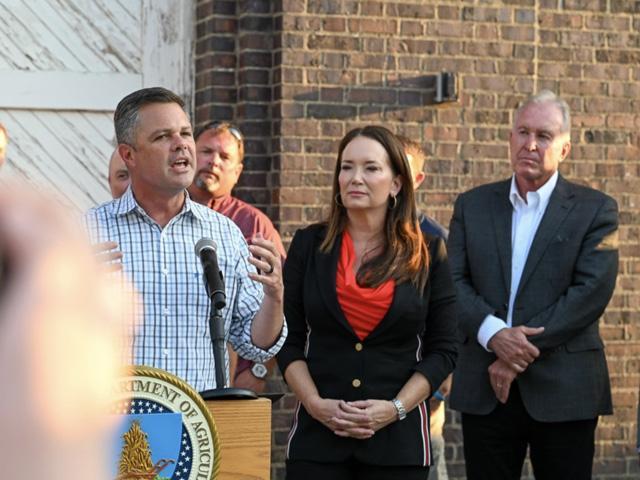
Rep. Zach Nunn, R-Iowa, speaks at the 2026 Iowa State Fair, after a USDA data modernization listening session with Agriculture Secretary Brooke Rollins. Nunn was one of the first elected leaders to speak with the administration after Trump’s beef import announcement, but Republican pressure to end the foreign beef plan failed. (Photo courtesy of USDA)
WASHINGTON (DTN) -- The House passed a short-term funding bill on Tuesday, and some Republicans are now turning their attention to the White House, pressing President Donald Trump to rethink a beef import policy that ranchers say is undercutting American producers.
The House passed the Senate version of a continuing resolution to fund the government through Dec. 11, avoiding a potential government shutdown when the fiscal year ends Sept. 30.
The measure passed 370-48, with 19 Republicans and 29 Democrats voting against it. Fourteen members did not vote. The president is expected to sign the bill.
Next, some farm-state Republicans are heading to the White House this week before an anticipated meat processing deregulation announcement.
Trump is expected to release "legal documents to be drawn in order to allow our great farmers and ranchers the right to process their own food," Anna Kelly, a White House spokesperson, told DTN.
Agriculture Secretary Brooke Rollins has said at both the Nebraska State Fair and the Farm Progress Show this week that additional announcements would follow the meat processing reforms hinted last week. She has specifically pointed to a forthcoming announcement with Trump.
Rep. Zach Nunn, R-Iowa, and other House Republicans are heading to the White House to discuss concerns raised by ranchers, "intentionally," before those end-of-week meat processing decisions.
"I'm going to give him the feedback. My ranchers asked me to provide it to the president. I think he needs to hear that," Nunn told DTN Tuesday.
It remains unclear how Trump's and Rollins' next steps -- including potentially waiving processing regulations, expanding ranchers' ability to sell meat across state lines, rescinding outdated guidance and using technology to speed food safety data -- could change following Republicans' trip to the White House later this week.
Republicans have spoken strongly against last week's move to expand beef imports, though their efforts have so far had little effect, as the new imports began Sept. 1.
Rollins used her appearances in farm country to defend the administration's beef import policy, which has faced criticism from ranchers, while pointing to heifer insurance policies and potential meat processing deregulation as wins for the ranching community.
Many Republicans still support Trump but have broken with him on the beef policy.
"If you're going to do something America First, it better start with America's growers and particularly our ranchers," Nunn said.
Another Midwestern member of Congress who spoke to DTN, but who wished to remain anonymous, said that ranchers are irritated by the policy because it suggests the president wants to make beef prices a central campaign issue.
"They think that's a hyper-focus on beef that isn't appropriate, given the cost of health care, given the cost of gasoline, given the cost of housing," the member of Congress said.
Farm Operations
DTN’s data science helps our members make important fields and grain marketing decisions. Learn more about our membership plans.



Still, Republicans are giving the administration some leeway to follow through on its broader plans. "You can't fault the guys for trying to find a pathway," Nunn said.
The conversations about the administration's beef import policy come as new reporting by the Wall Street Journal on Tuesday revealed an Aug. 20 Oval Office meeting between Trump and Brazilian Joesley Batista, one of the largest shareholders of JBS, the world's largest meat processing company.
The meeting occurred a day before Trump announced dropping out-of-quota beef import tariffs. As of June 2026, Brazil was the U.S.'s second-largest source of imports, accounting for $1.7 billion of product, up 21% from the previous month.
"I think (ranchers), they're more irritated by the market manipulation as a concept," the member of Congress who spoke to DTN on the condition of anonymity said.
HEMP AND GOVERNMENT FUNDING
The Senate version of the continuing resolution also included a separate agriculture provision that delays implementation from Nov. 12 to Dec. 11 of a ban on hemp products containing enough concentrated tetrahydrocannabinol, or THC -- the main psychoactive compound in cannabis -- to produce a "high."
The hemp industry hopes the additional time will allow stakeholders to reach a consensus on regulations that would allow some products to remain on the market while addressing concerns about potential health risks.
Both House Appropriations Committee Chairman Tom Cole, R-Okla., and Rep. Rosa DeLauro, D-Conn., the committee's ranking member, endorsed the bill and urged members to support it. In speeches on the House floor, no member mentioned the hemp provision, even though it was not included in the continuing resolution the House initially passed before the Senate amended and returned the measure.
Republicans voting against the bill included Rep. Andy Harris, R-Md., chairman of the House Agriculture Appropriations Subcommittee and chairman of the House Freedom Caucus.
Harris worked with Sen. Mitch McConnell, R-Ky., on the hemp restrictions enacted last year. Hemp was illegal throughout much of the 20th century because of its close association with marijuana.
McConnell was instrumental in convincing Congress to legalize hemp but later said he did not anticipate that hemp-derived products would be developed and marketed as intoxicants.
Harris has acknowledged the products' popularity but has argued that they are "not harmless."
DTN Washington Correspondent Jerry Hagstrom contributed to this report.
Jake Zajkowski can be reached at jake.zajkowski@dtn.com
Follow him on social platform X @jzajkow
(c) Copyright 2026 DTN, LLC. All rights reserved.