


Gulke: Where Is the Top?
The views expressed are those of the individual author and not necessarily those of DTN, its management or employees.



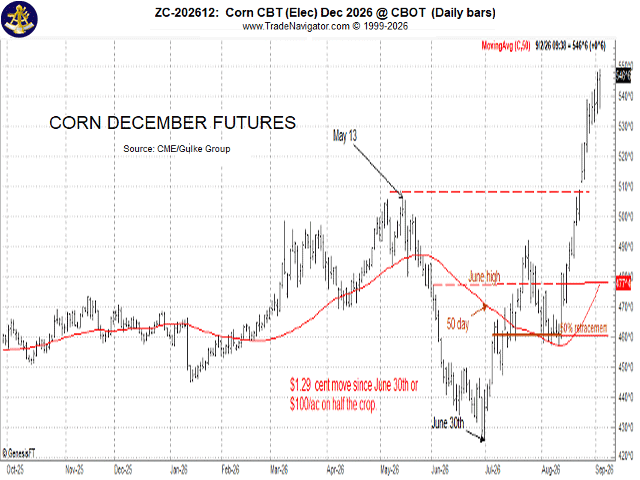
(Chart by Gulke Group)
It looks like last week’s column, “The Ship Has Sailed,” was right on target, as markets continued to climb that wall of worry. While the media were still trying to jump on board the sailing ship, some were, in fact, jumping off the ship of worry. That’s how bull/bear markets work.
One of my long-standing views is that when the majority are on the same page, few are left to buy the top of a bull market. Consequently, few are left to sell at the bottom of a bear market. Just go back in time — first to June 30 and then to Aug. 30, 2024 — when I felt markets had changed for the long haul.
Now the main question, even from those still short grain markets, is this: How high is high enough? For my part, I can lead readers to take a drink at the bull tank, but when markets rise at nearly a 70-degree angle, it is very difficult to determine when our price discovery system has found such a price through the demand-rationing process.
The geopolitical situation we are expected to navigate is unprecedented, and one most have not experienced in their lifetime. Many who are trying to write or speak on the outlook will default to saying “Put a floor under the market” — using put options that expire worthless as prices rise, to the point that a producer grows tired of spending money on options that yield nothing. Or the advice becomes “Sell some cash grain and buy a call” if you think prices are going higher.
In both cases, it costs a lot of money. For example, a March at-the-money call on Wednesday morning costs 32 cents, which means that by Feb. 21, futures will have to rise 14 cents (the December-to-March spread) plus the 32-cent call premium — or 46 cents total — putting March futures at $5.92. For someone to suggest that strategy implies they may not have a clear read on price direction but will recommend anything that benefits the buyer seeking physical control of the product, the firm that sold the call and the broker who earned the commission.
A lot of people with no skin in the game — no producer corn, in this case — reaped a reward, while the producer sold the grain and paid essentially 48 cents for the right to do so. It is no wonder most buyers don’t raise grain; they can buy it cheaper from the producer in most cases.
How high is high enough? Everyone has an opinion. Every media pundit weighs in on chat platforms or TV. Opinions are like noses — everyone has one. Market outlook is complicated, especially for the uninformed or unaware, and that includes some in the media who weren’t around during the last bull market — and some who were but aren’t about to share an opinion for free.
There is an old saying in the trade: “Talk is cheap; it takes good money to buy whiskey.” The advice a week or so ago to sell all old crop and some new crop — because we might not see these prices again — was correct, for a change. Prices surged higher and may not return.
I’ll leave you with the daily price chart of December corn accompanying this column. The long-term weekly and monthly charts are even more impressive. If you have questions, send a request to info@gulkegroup.com, and we’ll be in touch, or call Jamie at 707-365-0601.
Jerry Gulke can be reached at (707) 365-0601 or by email at Jerry@gulkegroup.com
(c) Copyright 2026 DTN, LLC. All rights reserved.