


Gulke: Boots on the Ground
The views expressed are those of the individual author and not necessarily those of DTN, its management or employees.



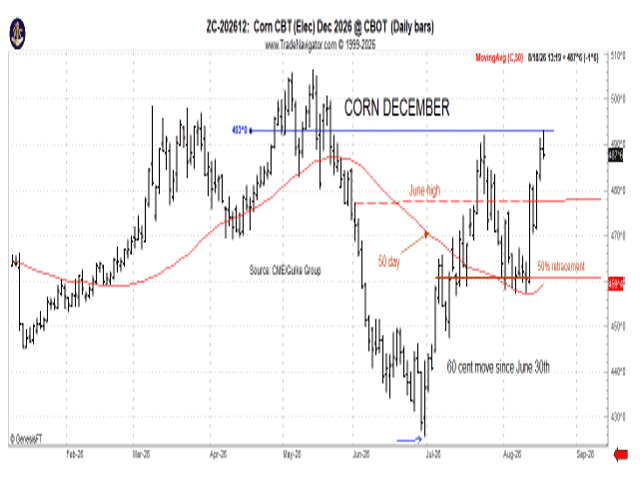
(Chart by Gulke Group)
The bottom-line comment last week, ahead of the August WASDE report, was this: ” If the report doesn’t hold a surprise for someone, then it was a waste of time and energy to try to anticipate the WASDE report.” Anticipating a surprise, I noted there was merit in looking at September options — either puts or calls, or, if on the fence, buying both. Since the report’s release, corn is up 28 cents and soybeans are up 48 cents. Given my bias against yield increases — despite what StoneX thought — I leaned toward holding the $4.50 corn call and the $12.00 bean call. The question now is what to do at expiry Friday.
There are two choices: Let the options expire and, if in the money, convert to long futures — or take the profits if available and risk a surprise in Pro Farmer’s final analysis after markets close Friday. Having been blindsided by closed-door decisions before, I’m leaning toward taking profits while they’re still on the table. Besides, having lifted hedges by June 30, another dilemma already exists.
MARKET REVIEW
For the past two years, a classic bull market has been quietly evolving — seemingly unnoticed by the media, including most ag economists. I’ll admit I had no illusions it would be anything less. Bull markets can’t develop and sustain if everyone is correct. Since completing the lifting of hedges on June 29, market action has been rewarding:
— Corn has gained more than 60 cents, or roughly $120 per acre, on unsold bushels.
— Soybeans rose more than $1, climbing $1.25 by July 27 before retracing 50% of that gain, finding support at obvious value points and rallying since.
— Chicago wheat also rose more than a dollar in the same period, retraced 50% and has rallied — complicated by global “spreaders” who like to be short something against something else, muddying the picture of real global wheat supply problems.
— The media trade is now on board, with “what ifs” popping up everywhere, replacing the negative bias that dominated coverage for the past two years, including since Jan. 2, 2026.
— Short-term daily signals have turned positive again, with short-, medium- and long-term momentum back on track, as it was in August 2024.
I’m even hearing talk of lofty price levels that may be needed if some of those “what ifs” come to pass. It’s been five or six years since the market has had to grapple seriously with price rationing demand. With plenty of newer media voices inexperienced in navigating bull markets, I’ll leave that analysis to more seasoned observers — and use them to pressure-test my own outlook.
This isn’t my first rodeo. The past two years have played out in classic fashion through the price discovery mechanism we rely on for managing price risk — both on the downside and the upside.
It will be interesting to see how this all unfolds, particularly with China absent from the corn and wheat markets and South American weather and production concerns already in the mix. I said some time ago that most general media analysts wouldn’t recognize a bull market if it came walking right down the street — and I suspect the top will be just as unrecognizable as the bottom was two years ago.
Crop ratings were down again Monday, with even a 1-point decline suggesting further deterioration. See the updated tables accompanying this week’s column. What will NASS find in the fields next month?
All of this with China still on the sidelines in corn and wheat markets.
Jerry Gulke can be reached at (707) 365-0601 or by email at Jerry@gulkegroup.com
(c) Copyright 2026 DTN, LLC. All rights reserved.