


Animal Health Officials, Secretary Rollins Assure Producers They Will Help Fight NWS
New World screwworm has emerged in Texas, prompting urgent calls for livestock producers across the country to implement preventative practices, increase surveillance, and report suspicious cases immediately. A producer meeting served as an educational event for all attending.



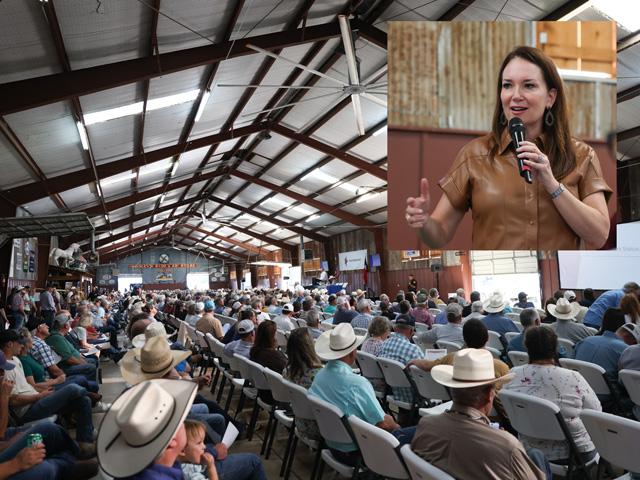
U.S. Secretary of Agriculture Brooke Rollins addressed a packed room during a livestock producer and landowner meeting in Fredericksburg, Texas, on June 17. (DTN photo by Erin Worrell)
The recent detection of New World screwworm (NWS) in Texas has made producers realize they need to be more aware of animal health. An informational meeting on June 17, in Fredericksburg, Texas, drew more than 1,000 livestock producers and landowners to hear the latest news and information on NWS from veterinarians, responding entities and fellow producers.
For many Texas livestock producers, NWS has been a semi-distant threat to be aware of, rather than something to manage, in their own operations. Now, that has changed.
While the situation continues to evolve, producers closest to the issue say there is one message they want the rest of the livestock industry to hear: Prepare now, stay vigilant and work with animal health officials.
“This is a management issue,” said Thomas “T.R.” Lansford III, deputy executive director and assistant state veterinarian for the Texas Animal Health Commission (TAHC). “It’s treatable, preventable and manageable.”
U.S. Secretary of Agriculture Brooke Rollins also addressed the overflow crowd to help dispel rumors about the spread of NWS in Texas. According to Rollins:
— NWS is not moving through Texas with weather systems or storms.
— NWS flies are not flying hundreds of miles directly from known infested zones in Mexico into Texas.
— NWS is not moving through meat or food products; this is a pest, not a virus or disease.
— NWS is not behaving in a way that suggests a widespread undetected establishment of the pest.
WHAT IS NEW WORLD SCREWWORM?
Unlike typical blow flies that feed on dead tissue, NWS flies lay eggs in wounds on live animals. The larvae hatch quickly and feed on healthy tissue, creating painful, destructive infestations.
According to Texas A&M AgriLife livestock entomologist Sonja Swiger, any opening in the skin can serve as an entry point, including navels on newborn animals, castration sites, dehorning wounds, injection sites, ear tag locations and even minor injuries.
The key to stopping the pest is to break its 21-day life cycle through prevention, early detection and rapid treatment.
Concerns were brought forward by auction barns and producers about restrictions and regulations by states regarding animals coming from infested states, as it has made a challenge for movement of sheep and goats, especially with Florida.
Rollins was quick to comment: “This is a top priority. We’ve talked about a couple of states that are being irrational and unreasonable. I will keep working on it, having some hard conversations.”
Texas livestock industry leaders are committed to working with state and federal officials to maintain market access while protecting animal health. Regulators emphasize that NWS is not a food safety issue, and that livestock movement can continue under established protocols.
Still, the economic consequences of NWS extend beyond the cost of treating an animal.
TAHC officials emphasize these practices:
— Inspect animals frequently.
— Treat navels immediately after birth.
— Monitor wounds closely.
— Minimize procedures that create wounds when practical.
— Treat injuries quickly before they become attractive to NWS flies.
— Maintain a veterinary-client-patient relationship.
Veterinarians said producers in areas without confirmed NWS cases should consider reviewing their calving, lambing, kidding and processing protocols now.
Treatments used to meet movement requirements require withdrawal periods that delay or complicate sales. Livestock from an infested zone that are inspected and deemed free of NWS can be sold or moved directly to slaughter without treatment for the pest. However, the movement document is only valid for three days after the date of inspection and thus not practical for the traditional auction market pathway and transport to a slaughter facility.
THE WILDLIFE WILDCARD
Wildlife surveillance is a critical pillar in rural NWS management. The vast increase in the deer and feral hog population in Texas from decades ago to now presents a significant risk of spreading NWS. The timing of these NWS cases coincides with the season of whitetail deer fawn births, presenting an ideal host for NWS.
Texas Parks and Wildlife Department (TPWD) is part of the statewide coordinated response effort and is monitoring the native wildlife population for NWS. They are contacting landowners to establish trapping and release locations, share educational information and encourage surveillance. Wildlife generally acts as a signal for early detection.
“The wildlife surveillance model will be important alongside the livestock and trap-based surveillance to help us demonstrate the absence of NWS in an area where we look to start trying to clear some of these zones up,” said Big Game Program Director Kory Gann, with Texas Parks and Wildlife Department.
REPORTING MATTERS
One consistent message has emerged from producers, veterinarians and industry officials: Report suspicious cases immediately.
There can be reluctance to report because producers worry about movement restrictions or increased oversight. However, officials say early reporting benefits both individual operations and the broader industry.
According to TAHC, when an NWS case is confirmed, that information helps direct sterile fly releases and response resources to the area.
“The goal is eradication, not blame,” said Harper Hesse, president, owner and manager of Chaparral Feeders in Uvalde, Texas. Hesse is in the surveillance zone and adjacent to the infested zone. “One missed case can affect an entire region.”
Industry leaders have repeatedly stressed that collecting and reporting any maggots in wounds of live animals is an extremely important action producers can take to help slow the spread of NWS.
“That reporting plan, when everyone follows that process — that’s how we’re going to defeat this and keep this from expanding,” said Wayne Cockrell, a producer representing Texas and Southwestern Cattle Raisers Association. “We as producers have a responsibility to other producers in our state and other states to do our best.”
WHAT TO EXPECT IF YOU’RE IN AN INFESTED ZONE
TAHC legally refers to an infected area as a quarantine zone for regulatory and emergency declaration purposes, but the zones operate under movement restrictions rather than a strict infectious disease quarantine.
Livestock movement is still possible, but additional steps may be required such as:
— Visual inspections.
— Movement documents.
— Treatment requirements or documentation for certain classes of animals.
— Animal identification records.
Movement requirements vary based on species, destination and whether animals are headed to slaughter.
TAHC officials say inspections are generally scheduled quickly, especially when producers provide advance notice. An online inspection training module is available for anyone, but certain authorized groups are eligible to become inspectors to ease the volume of inspections requested in NWS infected zones.
Maintaining continuity of business remains a major priority for regulators.
“We can’t shut down the state’s livestock industry with this pest,” Lansford said.
THE STERILE FLY STRATEGY
The primary long-term eradication tool remains sterile male NWS fly releases, the same approach that successfully eradicated screwworm from the United States decades ago.
USDA officials are currently deploying sterile NWS flies in response areas while expanding future production capacity.
Existing production capacity is at 100 million sterile flies per week, and only half are male. When NWS was last eradicated from the U.S., it took an effort of 500 million sterile flies released per week.
Government officials are a few years away from that capacity, making the efforts of individual livestock producers to monitor and prevent infestation a crucial component in slowing the spread of NWS.
Approval of the NoVoFly by the Environmental Protection Agency (EPA) could increase the rate of sterile male NWS fly production.
“The NoVoFly will allow the Panama facility to produce only sterile male flies. It allows us to double our efficacy and our output,” said Rollins. “Later this fall, we will have the equivalent of 400 million sterile flies without the Edinburg, Texas, facility even coming online yet.”
However, several industry representatives emphasize that sterile flies alone cannot solve the problem. Producers, veterinarians, wildlife managers and regulatory agencies all play critical roles.
As one industry panelist described it, success depends on a “three-legged stool” of prevention, reporting and movement controls.
THE BOTTOM LINE
Perhaps the strongest message from producers already dealing with NWS is that preparation outweighs reaction.
According to Lansford, “The most important thing we can put on our animals is eyes, finding those wounds early and treating them before they become infested.”
Most importantly, don’t ignore something suspicious.
“NWS does not respect fence lines, county lines or state lines,” Hesse said. “Silence helps it spread; vigilance helps stop it.”
The livestock industry eliminated NWS from the U.S. once before. Producers closest to the Texas NWS response believe a combination of awareness, cooperation and science can do it again.
NWS TREATMENT RESOURCES
— EPA approved pesticide products: https://www.aphis.usda.gov/sites/default/files/pesticides-for-nws.pdf
— FDA approved parasiticide products: https://www.fda.gov/animal-veterinary/safety-health/animal-drugs-new-world-screwworm
— For more DTN coverage of the New World screwworm threat and the response by the government and livestock industry, visit our Spotlight on New World Screwworm page at https://www.dtnpf.com/agriculture/web/ag/livestock/article/2026/06/08/dtn-coverage-new-world-screwworm-us.
(c) Copyright 2026 DTN, LLC. All rights reserved.