


Ultimate Ears
Pretty or not, the best hybrids deliver yield.


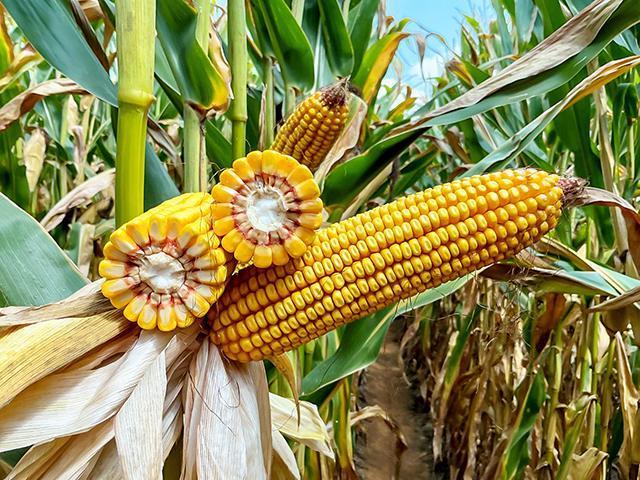
When it comes to corn yield, ear aesthetics don’t determine how quickly the grain tank fills on the combine. (Courtesy of GDM)
Beauty is in the eye of the beholder. And, for many grain farmers, a beautiful ear of corn has a certain look.
Yet, the yield they truly desire can come in many shapes and sizes.
Seed companies offer expansive corn hybrid portfolios differentiated by maturity, trait packages and other attributes, including ear characteristics. Some hybrids produce a fixed ear, where the number of kernel rows and length remain constant regardless of growing conditions. Others produce ears that flex, adding girth, length or kernel depth as the corn responds to population density and the environment. Despite the differences, the goal remains the same.
“When we’re evaluating hybrids, the top three priorities are yield, yield and yield,” says John Gill, a corn breeder with GDM, based in Kearney, Nebraska. “We’re not picky about how we get there. If it’s more kernel rows or more row length, that’s OK — as long as the hybrid gives us the yield.”
Gill explains that the GDM breeding team tests thousands of hybrids every year in search of the next commercial release that moves the needle higher. Sometimes, those winners aren’t so “pretty.”
“My first commercial hybrid was 14 rows around, which is not super desirable because it doesn’t look great,” he says. “Our precommercial folks had kind of written it off, and your first instinct was to say there’s no yield here because it doesn’t have enough rows. But, when you broke open that ear, those kernels were huge. That gets hidden. It topped our yield trials.”
While it’s tempting to chase an idealized notion of what a corn crop should look like, that method of plant improvement can have unintended consequences.
“It’s called breeding for an ‘ideotype,'” Gill says. “You’re in the field trying to chase a certain direction, maybe make a cross that adds two more kernel rows. But, you’re going to bring in something else that’s undesirable. So, instead of trying to design each cross with a specific outcome, we make a whole bunch of crosses, test them and then hope something comes out the back end.”
Tengfang Huang, head of research for The Traits Co., a technology venture of GDM, says many of the genes that control kernel number and shape have been identified. What is less understood is how corn plants sense stress and decide to change the size of the ear.
“That decision might make sense for the corn but not farmers,” he says. “We need to understand how corn makes these decisions and connect them to genes. Then, we will come up with different ways to modify the plant’s decision-making that will be better for farmers.”
Capturing sunlight, storing that energy and converting it into grain is the primary goal, Huang says. This means that plant architecture — the size, angles and shapes of leaves that maximize photosynthesis while avoiding competition with neighboring corn plants — is ultimately more important than the size and shape of the resulting grain.
“You are looking at the total output,” he says. “You don’t want the energy conversion processes to be the bottleneck for yield.”
**
— Follow Jason on social platform X @JasonJenkinsDTN
[PF_0926]
(c) Copyright 2026 DTN, LLC. All rights reserved.