


Soybeans Soar on Drop in Crop Ratings, EPA Ruling
Soybeans led the way higher on Tuesday, with November futures racing past the $13 mark en route to a sixth straight higher close. Soybean oil market anxiety was eased on Monday afternoon after the EPA announced that despite 1.76 billion RINs being exempted from 2025 mandated volumes, the added exemptions will be offset with higher blending requirements for 2026 and 2027. Corn and wheat futures traded higher as well Tuesday, with the latter unconvinced of the latest reports of Turkey's efforts to achieve a grain export deal in the Black Sea. Meanwhile, crude oil futures jumped to their highest price in six weeks Tuesday after two tankers were reportedly struck by missiles while attempting to cross the Strait of Hormuz Monday night. Inflationary concerns have taken hold of outside markets this week, with treasury yields moving sharply higher.


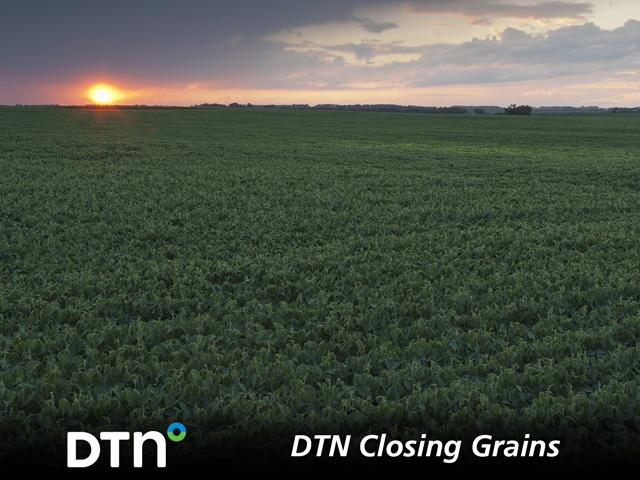
(DTN illustration by Nick Scalise)
GENERAL COMMENTS:
December corn closed up 8 1/4 cents and March corn was up 8 cents. November soybeans closed up 29 3/4 cents and January soybeans were up 29 1/2 cents. December KC wheat closed up 7 1/4 cents, December Chicago wheat was up 8 1/2 cents, December MIAX Minneapolis wheat was up 13 3/4 cents.
The U.S. Dollar Index is up 0.29 at 99.72. The Dow Jones Industrial Average is down 475.0 points at 52,765.0. December gold is down $105.30 at $4,376.20, December silver is down $2.16 at $64.84 and December copper is down $0.1585. October crude oil is up $4.64 at $90.40, October ultra-low sulfur diesel is up $0.2844, October RBOB gasoline is up $0.0661 and October natural gas is down $0.018.
CORN:
December corn futures closed up 8 1/4 cents on Tuesday to $5.46. March corn was up 8 cents to $5.60 1/4. The corn market posted a third straight session higher as well as a ninth higher in the past 10 sessions. A hot week ahead for the U.S. Corn Belt combined with already lower yield forecasts for the upcoming harvest, continue to drive prices higher, along with forward-looking world supply concerns. From a technical standpoint, December futures remain considerably overbought, though that has mattered little with traders not shying away from their bullish convictions in the past three weeks. The bullish target from here is July 2023 highs near $5.60 to $5.70. To the downside, the chart gap remains from $5.09 to $5.10 1/4, which would be a reasonable profit-taking target through fall, though the market has shown little retracement thus far.
In Monday’s Crop Progress report, USDA said that over half of the U.S. corn crop is in the dent stage as of this week at 62% nationally, that is 6 percentage points ahead of normal for late August. Meanwhile, 13% of the crop is mature. National crop ratings held steady with 57% of the crop considered to be in good-to-excellent condition, though that is 12 percentage points lower than in August 2025. State-by-state results showed considerable week-over-week improvement in Colorado, though only 30% of the state’s crop is now rated as good to excellent. Across the Midwest, there were very few notable changes, with Illinois, Indiana, and Iowa all flat, while Nebraska showed modest improvement, but the Dakotas declined. The two-week radar shows above-average temperatures combined with hit or miss rainfall across the Corn Belt. The heaviest rainfall totals look to favor the northern half of the belt.
Very little has changed within the world corn market outlook, with no substantial follow up optimism to Monday’s reports of the latest Turkey led push for a ceasefire in the Black Sea. While the U.S. stands to have another strong export year in 2026-27 amid the issues in the Black Sea coupled with a historically poor European corn crop — it is worth keeping in mind that U.S. prices sit quite a bit above Argentina and Brazil on a FOB basis. While U.S. sales of soybeans have soared year over year, new-crop corn sales were 34% behind 2025 as of Aug. 20.
The DTN National Corn Index finished Monday at $4.92. Tuesday’s futures close and Monday’s national average corn basis of 46 cents under the December board would indicate the index on Tuesday afternoon to be near $5.00.
SOYBEANS:
November soybean futures jumped 29 3/4 cents on Tuesday to $13.17 3/4. January futures were up 29 1/2 to $13.32 3/4. The November contract made easy work of the $13 mark on Tuesday, fueled by a drop in crop ratings in Monday’s USDA update with a hot two weeks on tap for the Midwest as well. Like corn and wheat, soybean futures are becoming considerably overbought over the short term, but that has done little to dissuade further buying with the November contract up for a sixth straight session. In fact, November soybeans haven’t traded lower for two consecutive sessions since the first week of August.
On Monday, USDA reported that 95% of U.S. soybeans have setting pods, still slightly ahead of average for late August. Thirteen percent of soybeans are dropping leaves, which is also ahead of average. National soybean conditions fell through the most recent week with 58% of the crop now rated good to excellent. Although this is a three-year low for late August, it is about average over the Crop Progress time series (1989-2025). Looking at state results, the top two producers, Illinois and Iowa, were steady through the week, with Iowa’s crop the highest rated in the nation at 77% good to excellent. However, other key states declined, with Minnesota (No. 3 producer) dropping 8 percentage points from good-to-excellent scores after a dry second half of August. Looking ahead, above-average heat may pose further issues for areas with low soil moisture. There is rainfall forecasted across the northern Soybean Belt, which may prove important for pod filling in drought-stricken areas.
World soybean news is slim, with China’s U.S. buying spree still going strong with another 5 million bushels (mb) flash sale reported Tuesday morning. September will be a big month for the world market, with Brazil set to begin planting their 2027 crop while China’s President Xi is expected to visit the U.S. toward the end of the month, the latter which could lead to market volatility similar to President Trump’s visit to Beijing in May. In product markets news, the soybean oil market breathed a huge sigh of relief after Monday’s EPA announcement — gapping higher on Monday evening and trading to six-week highs after the EPA said the difference between initial forecasts for small refinery exemptions and newly increased levels would be made up for in 2026 or 2027 blending obligations. Board crush margins remain historically strong and near $3.40 per bushel based on October oil and meal futures and November soybean futures.
The DTN National Soybean Index finished Monday at $12.50. Tuesday’s futures close and Monday’s national average soybean basis of 38 cents under the November board would indicate the index on Tuesday afternoon to be near $12.80.
WHEAT:
December Kansas City futures traded 7 1/4 cents higher on Tuesday to $8.45 1/4. Chicago and Minneapolis markets were also higher. Wheat futures continued their higher path Tuesday, building momentum after trading considerably lower early Monday. Traders are giving little weight to reports that Turkey is making efforts to secure safe passage for Black Sea grain exports, with all efforts through the past month being dead ends. That being said, after hitting another high for the move early Tuesday, KC futures did show some fatigue and ultimately fell over a dime below the daily high by the close. Should profit-taking set in, soft support is first seen near $8.25, which would be followed by a retest of the $8.00 level. Meanwhile, the upside target remains $9.00 or among the highs set back in 2023.
In Monday’s Crop Progress update, USDA reported that 77% of the U.S. spring wheat crop is harvested, still running well ahead of average for late August. With the harvest advancing beyond three-fourths complete, USDA did not publish crop condition ratings in this week’s update. For the U.S. market, attention will quickly shift to planting the 2027 winter wheat crop in the U.S. The sharp rise in prices would suggest on paper the potential for higher acreage compared to the historical lows in fall of 2025. However, there are other variables to consider including higher year-over-year fertilizer costs and over half of U.S. winter wheat area being in some level of drought as of USDA’s most recent update.
In world wheat news, Paris milling futures traded higher while setting another 2026 high and continuing to challenge levels not seen since the summer 2024. With world demand set to pick up through the fall and winter months, big questions remain as to where supplies will be sourced, as well as how demand will hold up with buyers now facing drastically higher prices. Some relief may be coming from the Southern Hemisphere with crop prospects for Australia surprisingly improved through the growing season, though weather will still have a role to play over the next month or so. Reports out of Argentina have also been of higher-than-expected acreage, and the crop is highly rated by the Buenos Aires Grain Exchange.
The DTN National HRW Index finished Monday at $7.65, while the DTN National HRS Index was $7.05. Tuesday’s futures close and Monday’s national average basis of 73 cents under the December board for HRW, and 58 cents under the December board for HRS, would indicate the indices for Tuesday afternoon to be near $7.73 and $7.19, respectively.
Rhett Montgomery can be reached at Rhett.Montgomery@dtn.com
(c) Copyright 2026 DTN, LLC. All rights reserved.