


Gulke: Market Collapse Timeline
The views expressed are those of the individual author and not necessarily those of DTN, its management or employees.



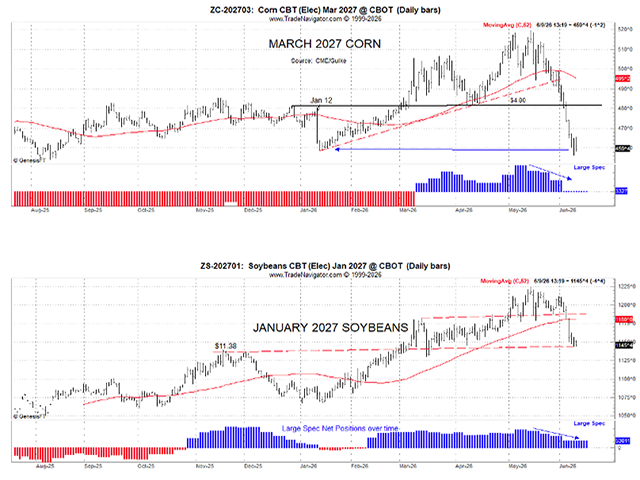
(Charts by Gulke Group)
If nothing was learned from the last three weeks of trading, my efforts in this column were in vain. To recap:
— The 18-month positive bias — what I called a paradigm shift — ended right on schedule the first week of March.
— Corn rallies, for whatever reason — fundamental, weather or political — normally have such news discounted within six to eight weeks, depending on their strength.
Corn bottomed Jan. 13 on the acreage and yield shock from the Jan. 12 report, then topped six weeks later on March 9 following the Iranian attack. Soybeans, crude oil and bitcoin followed suit a few days earlier. In fact, none of the above made new highs after that — at least not yet.
— That same herd, particularly corn and soybeans, spent the next five to six weeks trying to close above the March and April highs, and tried again in May.
Those markets topped right on the normal schedule — May 13, not Feb. 21 as last year. Media TV and radio analysts got that wrong.
— The rest is history. Prices fell through what was thought to be the floor of the support channel, even as many hoped the Trump-Xi summit would deliver a bullish catalyst. It did not — at least not with the immediate gratification some expected.
The bottom of the corn channel turned out to be only halfway to the current low. December corn posted a daily key reversal straight through that support line like a hot knife through butter.
— The market took back all of corn’s and wheat’s gains in 2026 and half of soybean gains — in new-crop futures. That translates to $180 per acre for corn, $53 per acre for soybeans and $1 per bushel for Chicago wheat.
That made the higher costs of fertilizer, fuel and chemicals seem like moot points — especially when not one land-grant university or commodity group focused on marketing. Instead, the conversation centered on complaining about input costs. Politicians said little but looked for someone to blame. The media tried to blame the war or crude oil, but those look more like excuses than valid explanations.
The market giveth and the market taketh away. So, now what?
The paradigm shift the market anticipated 18 months ago appears to have ended with a thud. The reality of that has fallen largely on crop insurance, with little apparent interest in financial risk management — even from bankers who have learned to sell insurance to their clients.
What hasn’t changed in the 20 or so sheets released since the summit: If prices aren’t low enough with what we know — or should know — about the marketing year beginning Sept. 1, I’m not sure what price will awaken the sleeping bear in the room (China), or whether President Trump has an unknown card to play in time for the fall election.
It is June 9 — not July 9 or Aug. 9 — and I am relying on the same methodology used in this column to look ahead and recognize whether a new paradigm shift is emerging, or whether the old one will wake from hibernation and resume the rally.
If responses to the last 18 months of commentary are any indication, the psychological shift I may have missed is this: regardless of all the schemes involving crop insurance, accumulator programs and the like, in the final analysis, our production is sold at whatever price discovery deems valid. In the end, we cannot produce our way into prosperity — contrary to what fertilizer, chemical and seed companies and many economists would have us believe.
Blaming computer trading, algorithms or AI doesn’t hold up, either. Corn has had its biggest price drop in 17 years. Algorithms, high-speed trading and AI weren’t around back then — yet it still happened. So, whom can we really blame? Are we chief financial officers, or just plant managers?
The updated charts accompanying this column offer a visual dose of reality.
Jerry Gulke can be reached at (707) 365-0601 or by email at Jerry@gulkegroup.com
(c) Copyright 2026 DTN, LLC. All rights reserved.