


Gulke: Jan Soybeans Flashing Concerns
The views expressed are those of the individual author and not necessarily those of DTN, its management or employees.



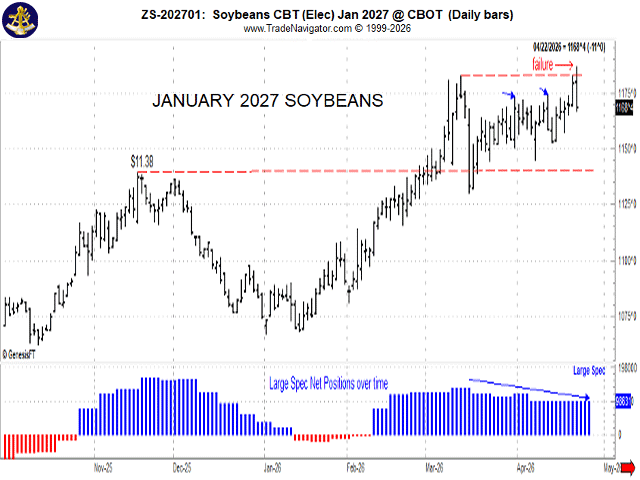
Last week’s column focused on skepticism that corn prices were being influenced by the Iranian War and/or crude oil prices. As this chart shows, November soybean prices also deserved the same skepticism. (Chart by Gulke Group)
Last week’s column focused on my skepticism that corn prices were being influenced by the Iranian War and/or crude oil prices. As the accompanying chart shows, November soybean prices also deserved the same skepticism.
While there was indeed volatility, soybeans basically went in a sideways trading pattern, unable to exceed the March (start of the war) high and the 70-cent drubbing thereafter. They settled about halfway between the high and low for March while waiting for another shoe to drop.
There is more to the sideways trading affair than the media would lead you to believe. A few bullet points to consider:
— The highest level in March was $11.82 1/2; the highest close $11.73 1/2.
— The absolute high in April, $11.82 1/2 Tuesday, matched the March high.
— Wednesday, April 22, January soybeans exceeded the March high, looking back, as it headed to greener pastures, but failed and posted a daily key reversal lower. Soybean oil (not shown) did a similar trick.
— There were daily key reversals lower and higher, but in each case, they failed to extend higher or lower, as if waiting for a bullish or bearish shoe to drop.
— Wednesday appears to have been that day, as U.S. Trade Representative Greer said he was looking for a broader set of agricultural goods in the meeting with China planned for next month.
— Coincidentally, the stab lower in April stopped at the post-harvest high made in November, which added to the price discovery in March/April.
— As a further side note, large specs have been reducing their net positions recently.
There are further implications of what has been going on for the past six weeks regarding soybeans’ attempt to extrapolate the good news from the biofuels mandate and higher crude prices that may help biofuels. Anecdotal evidence has been surfacing in reports from seed companies and others in agricultural media that corn acreage has been switching to soybeans for various reasons — the most obvious, of course, being cost and availability of corn fertilizers. The answer likely won’t come until June 30’s Plantings report.
Market psychology is what it is, and futures markets are in the business of discounting the future — not the past. That discounting is evident in how prices close. On Wednesday, the close was lower, after some apparent soul-searching by soybeans since the war began.
A high posted Wednesday over the March high has implications for the potential for April to close below the March low or into new highs for 2026. The market is in the process of deciding if sufficient acres have been or will be switched from corn to soybeans. No one said market analysis would be easy. I trust market price discovery will lead the way.
Jerry Gulke can be reached at (707) 365-0601 or by email at Jerry@gulkegroup.com
(c) Copyright 2026 DTN, LLC. All rights reserved.