


USDA Crop Progress: Corn Rated 68% Good to Excellent; Soybeans 66% Good to Excellent as of June 21
Corn was rated 68% in good-to-excellent condition, and soybeans were rated 66% in good-to-excellent condition as of Sunday, June 21. Winter wheat harvest reached 40% complete.


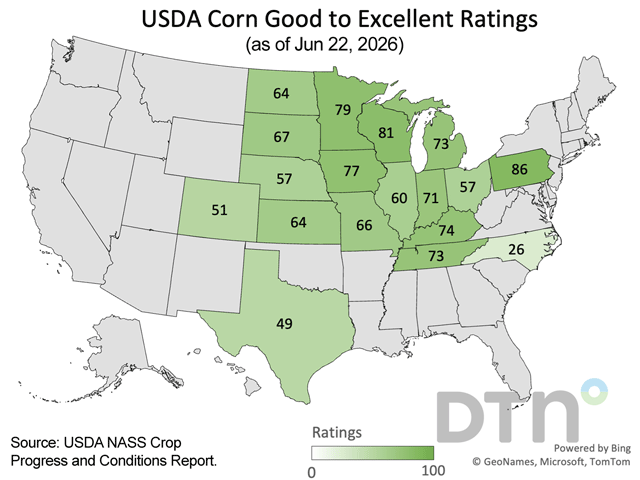
This map shows corn condition ratings by state, according to USDA NASS estimates released Monday. (DTN graphic by Nick Scalise)
This article was originally published at 3:05 p.m. CDT on Monday, June 22. It was last updated with additional information at 3:51 p.m. CDT on Monday, June 22.
**
OMAHA (DTN) — The latest USDA NASS Crop Progress report showed U.S. corn and soybean conditions unchanged from the previous week.
Widespread rainfall has reduced drought and kept soil moisture high across the Corn Belt with generally good crop conditions, though flooding, severe weather, and upcoming heat remain key concerns, according to DTN Ag Meteorologist John Baranick.
CORN
— Crop development: 97% of corn had emerged as of Sunday, steady with last year’s pace and the five-year average. Corn silking was pegged at 5%, 1 percentage point ahead of last year’s 4% and 2 percentage points ahead of the five-year average of 3%.
— Crop condition: NASS estimated that 68% of the crop was in good-to-excellent condition, steady with the previous week and 2 points below last year’s 70%. Six percent of the crop was rated very poor to poor, steady with the previous week and previous year. Top-producing Iowa’s crop remained rated 77% good to excellent, while Illinois led states in declines, losing 6 points in its good-to-excellent rating through the week on reports of wind and hail damage, according to DTN Lead Analyst Rhett Montgomery.
SOYBEANS
— Crop development: 93% of soybeans had emerged as of Sunday, 4 points ahead of last year’s pace and 3 points ahead of the five-year average of 90%. Soybeans blooming was pegged at 9%, 2 points ahead of last year’s 7% and 3 points ahead of the five-year average of 6%.
— Crop condition: NASS estimated that 66% of soybeans that had emerged were in good-to-excellent condition, steady with the previous week and previous year. Meanwhile, Illinois, Iowa and Minnesota — the top three producing states — all saw weekly declines in crop ratings, though Iowa and Minnesota both remained above 70% good to excellent, Montgomery said.
WINTER WHEAT
— Harvest progress: Harvest moved ahead 15 percentage points last week to reach 40% complete nationwide as of Sunday. That was 22 points ahead of last year’s 18% and 16 points ahead of the five-year average pace of 24%. Texas’ winter wheat is at 77% complete, 9 points ahead of last year and the five-year average of 68%. Oklahoma harvest reached 95% complete compared to 73% last week, 61 points ahead of last year’s 34% and 34 points ahead of the five-year average of 61%.
— Crop condition: An estimated 26% of winter wheat was rated good to excellent as of June 21, down 1 point from 27% the previous week and 23 points below 49% a year ago, according to NASS.
SPRING WHEAT
— Crop development: Sixteen percent of spring wheat was headed, 1 point ahead of last year’s pace of 15% and steady with the five-year average.
— Crop condition: NASS estimated that 54% of the crop was in good-to-excellent condition nationwide, down 1 point from 55% the previous week.
THE WEEK AHEAD IN WEATHER
Crop conditions remain generally good thanks to widespread beneficial rainfall and mild temperatures, but flooding, severe weather and an emerging heat pattern will be important to watch, according to DTN Ag Meteorologist John Baranick.
“A lot of the talk recently, and deservedly so, has been the widespread rainfall that has helped to reduce drought and keep soil moisture high across a lot of the Corn Belt,” Baranick said. “That has helped to keep crop conditions in general good order. But the frequency of flooding, especially around Missouri, and the higher instances of large tornadoes and hurricane-force winds should not go unnoticed. Both the heavy rain and severe weather hit the Central Plains over the weekend, which may not show up in the crop progress report this week. But we could be seeing some troubles as we get more and more fields to have issues with quality (in the case of heavy rain and damage for winter crop harvest), or production (in the case of flooding and green snap in the Corn Belt).
“Otherwise, the rainfall has been rather widespread and beneficial. Temperatures have been milder outside of Texas, and crop development should be going well due to the recent conditions. That continues here again this week as we get multiple systems and fronts to continue the showers and thunderstorms this week, hitting more of the Plains and western Corn Belt than recent weeks. Temperatures will remain mild again outside of the far Southern Plains and Gulf Coast, keeping stress low. We will see the start of a pattern change this weekend though, with higher temperatures and heat spreading through more of the country east of the Rockies for the start of July. How long that lasts will be important to follow for crop conditions going forward. But in the short term, the increasing temperatures will help to make up some of the growing degree day deficits in some areas.
“Areas to watch for issues would be the flooding in the South and Southeast, and dryness in the Pacific Northwest.”
**
To view weekly crop progress reports issued by National Ag Statistics Service offices in individual states, visit http://www.nass.usda.gov/. Look for the U.S. map in the “Find Data and Reports by” section and choose the state you wish to view in the drop-down menu. Then look for that state’s “Crop Progress & Condition” report.
**
Editor’s Note: How are your crops looking? Are they better, worse or right on track with USDA NASS’ observations this week? Send us your comments, and we’ll include them in next week’s Crop Progress report story. You can email comments to talk@dtn.com. Please include the location of where you farm.
**
| National Crop Progress Summary | ||||
| This | Last | Last | 5-Year | |
| Week | Week | Year | Avg. | |
| Corn emerged | 97 | 94 | 97 | 97 |
| Corn silking | 5 | NA | 4 | 3 |
| Soybeans emerged | 93 | 88 | 89 | 90 |
| Soybeans blooming | 9 | NA | 7 | 6 |
| Winter wheat harvested | 40 | 25 | 18 | 24 |
| Spring wheat headed | 16 | 6 | 15 | 16 |
| Cotton planted | 92 | 86 | 91 | 94 |
| Cotton squaring | 27 | 19 | 25 | 25 |
| Cotton setting bolls | 5 | 2 | 5 | 5 |
| Sorghum planted | 84 | 68 | 82 | 84 |
| Oats headed | 61 | 50 | 58 | 58 |
| Barley headed | 20 | 7 | 15 | 14 |
| Rice headed | 13 | 8 | 12 | 8 |
| Sunflowers planted | 95 | 82 | 89 | 90 |
| Peanuts pegging | 23 | 12 | 24 | 23 |
**
| National Crop Condition Summary | |||||
| (VP=Very Poor; P=Poor; F=Fair; G=Good; E=Excellent) | |||||
| VP | P | F | G | E | |
| Corn | |||||
| This Week | 1 | 5 | 26 | 56 | 12 |
| Prev Week | 1 | 5 | 26 | 56 | 12 |
| Prev Year | 2 | 4 | 24 | 56 | 14 |
| DTN 5-Yr Avg | 5 | 10 | 26 | 46 | 13 |
| Soybeans | |||||
| This Week | 1 | 5 | 28 | 56 | 10 |
| Prev Week | 1 | 5 | 28 | 57 | 9 |
| Prev Year | 2 | 5 | 27 | 56 | 10 |
| DTN 5-Yr Avg | 4 | 10 | 28 | 47 | 11 |
| Spring Wheat | |||||
| This Week | 1 | 5 | 40 | 50 | 4 |
| Prev Week | 1 | 5 | 39 | 51 | 4 |
| Prev Year | 3 | 12 | 31 | 49 | 5 |
| DTN 5-Yr Avg | 8 | 16 | 29 | 40 | 7 |
| Winter Wheat | |||||
| This Week | 20 | 26 | 28 | 22 | 4 |
| Prev Week | 20 | 25 | 28 | 22 | 5 |
| Prev Year | 6 | 13 | 32 | 43 | 6 |
| DTN 5-Yr Avg | 14 | 18 | 31 | 32 | 6 |
| Rice | |||||
| This Week | 0 | 2 | 27 | 55 | 16 |
| Prev Week | 1 | 2 | 27 | 55 | 15 |
| Prev Year | 0 | 2 | 20 | 57 | 21 |
| DTN 5-Yr Avg | 1 | 3 | 22 | 58 | 17 |
| Oats | |||||
| This Week | 7 | 12 | 28 | 47 | 6 |
| Prev Week | 7 | 12 | 29 | 47 | 5 |
| Prev Year | 7 | 9 | 27 | 49 | 8 |
| DTN 5-Yr Avg | 7 | 9 | 30 | 48 | 6 |
| Barley | |||||
| This Week | 1 | 5 | 45 | 47 | 2 |
| Prev Week | 1 | 5 | 47 | 45 | 2 |
| Prev Year | 1 | 14 | 43 | 40 | 2 |
| DTN 5-Yr Avg | 1 | 7 | 39 | 48 | 4 |
| Peanuts | |||||
| This Week | 2 | 5 | 30 | 58 | 5 |
| Prev Week | 1 | 4 | 33 | 57 | 5 |
| Prev Year | 1 | 4 | 23 | 64 | 8 |
| DTN 5-Yr Avg | 2 | 8 | 32 | 51 | 7 |
| Cotton | |||||
| This Week | 3 | 10 | 34 | 45 | 8 |
| Prev Week | 2 | 9 | 39 | 41 | 9 |
| Prev Year | 6 | 14 | 33 | 41 | 6 |
| DTN 5-Yr Avg | 12 | 17 | 30 | 34 | 6 |
EllaMae Reiff can be reached at ellamae.reiff@dtn.com
Follow her on social platform X @ellareiff
(c) Copyright 2026 DTN, LLC. All rights reserved.