


USDA Crop Progress: Corn 18% Harvested, Soybeans 17% Harvested as of Sept. 27
Corn was 18% harvested, and the remaining crop was rated 57% in good-to-excellent condition as of Sunday, Sept. 27. Soybeans were 17% harvested and were rated 58% in good-to-excellent condition.


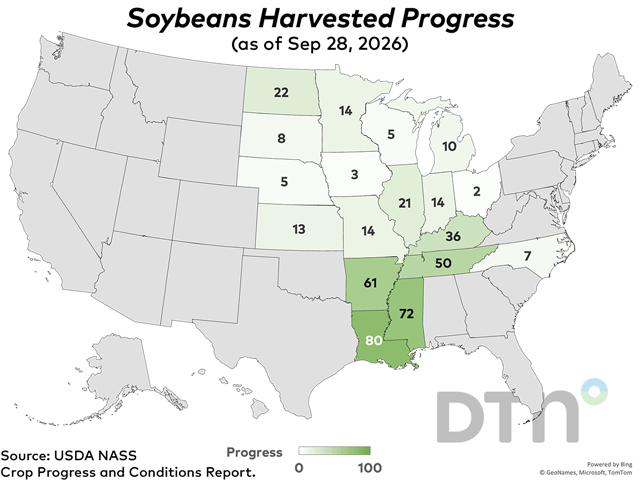
This map shows soybean harvest progress by state for the week ending Sunday, Sept. 27, according to USDA NASS. Nationwide, 17% of the crop was harvested, equal to the five-year average. (USDA NASS data; DTN graphic by Kathy Myers)
This article was originally published at 3:05 p.m. CDT on Monday, Sept. 28. It was last updated with additional information at 4:32 p.m. CDT on Monday, Sept. 28.
**
OMAHA (DTN) — After running ahead of normal the past few weeks, U.S. corn and soybean harvest progress slowed last week, bringing both crops back in line with the five-year average pace, according to USDA NASS’s weekly Crop Progress report released Monday.
Disruptions to harvest activity and winter wheat seeding could continue this week, as heavy rainfall is forecast across the Central and Southern Plains. But the moisture could substantially improve drought conditions and bolster wheat prospects heading into fall, according to DTN forecasts.
CORN
— Crop development: Corn dented was estimated at 96%, 2 percentage points ahead of last year’s 94% and 1 point ahead of the five-year average of 95%. Corn mature was pegged at 72%, 3 percentage points ahead of last year’s 69% and 1 percentage point ahead of the five-year average of 71%.
— Harvest progress: NASS estimated that 18% of corn had been harvested nationally as of Sept. 27, 1 percentage point ahead of last year’s 17% and now equal to the five-year average.
— Crop condition: NASS estimated that 57% of the crop remaining in fields was in good-to-excellent condition, unchanged from the previous week but 9 percentage points below last year’s 66%. Seventeen percent of the crop was rated very poor to poor, equal to the previous week and 7 percentage points above the previous year’s 10%.
SOYBEANS
— Crop development: Soybeans dropping leaves were pegged at 75%, 1 percentage point behind last year’s 76% and equal to the five-year average.
— Harvest progress: NASS estimated that 17% of soybeans had been harvested as of Sunday, 1 point behind last year’s pace of 18% and now equal to the five-year average.
— Crop condition: NASS estimated that 58% of soybeans were in good-to-excellent condition, unchanged from the previous week but 4 percentage points below the previous year’s 62%.
WINTER WHEAT
— Planting progress: Winter wheat planting was estimated at 27% complete nationally, 5 percentage points behind last year’s 32% and 7 percentage points behind the five-year average of 34%.
— Crop development: Winter wheat emerged was estimated at 8%, 4 points behind last year’s 12% and 3 points behind the five-year average 11%.
THE WEEK AHEAD IN WEATHER
A slow-moving front and moisture from the remnants of Hurricane Polo are expected to produce another week of widespread rainfall across the central United States, extending a wet pattern that has complicated fieldwork but improved soil moisture in key wheat-growing areas, DTN Ag Meteorologist John Baranick said.
“It’s another wet week ahead for the middle of the country, the third in a row,” Baranick said. “A front will be pushing across the country this week, but that’s not the only issue. The remnants to Hurricane Polo will move across Mexico and into the Southern U.S. early this week. When combined with the front, it will make for widespread areas of 2-4 inches of rain for the Central and Southern Plains. Areas of more than 2 inches could also affect Iowa and Missouri as well. The rain won’t be nearly as heavy in other parts of the country, but the front will be slower to move through the Southeast late this week and weekend, which could cause totals to rise there as well.
“While the heavy rain will disrupt harvest as well as winter wheat planting, it will help ease the ongoing drought in the Central and Southern Plains immensely, being a net positive for winter wheat in the long run. And after this system moves through, the pattern looks a lot quieter through early October, allowing some of these wetter areas to dry out with time.”
**
To view weekly crop progress reports issued by National Ag Statistics Service offices in individual states, visit http://www.nass.usda.gov/. Look for the U.S. map in the “Find Data and Reports by” section and choose the state you wish to view in the drop-down menu. Then look for that state’s “Crop Progress & Condition” report.
**
Editor’s Note: How is your harvest going? Send us your comments, and we’ll include them in next week’s Crop Progress report story. You can email comments to talk@dtn.com. Please include the location of where you farm.
**
| National Crop Progress Summary | ||||
| This | Last | Last | 5-Year | |
| Week | Week | Year | Avg. | |
| Corn dented | 96 | 92 | 94 | 95 |
| Corn mature | 72 | 58 | 69 | 71 |
| Corn harvested | 18 | 13 | 17 | 18 |
| Soybeans dropping leaves | 75 | 62 | 76 | 75 |
| Soybeans harvested | 17 | 12 | 18 | 17 |
| Winter wheat planted | 27 | 17 | 32 | 34 |
| Winter wheat emerged | 8 | 2 | 12 | 11 |
| Cotton bolls opening | 70 | 65 | 66 | 67 |
| Cotton harvested | 17 | 13 | 15 | 15 |
| Sorghum coloring | 93 | 88 | 92 | 94 |
| Sorghum mature | 67 | 56 | 60 | 63 |
| Sorghum harvested | 29 | 25 | 28 | 31 |
| Barley harvested | 98 | 94 | 98 | 96 |
| Rice harvested | 80 | 73 | 76 | 69 |
**
| National Crop Condition Summary | |||||
| (VP=Very Poor; P=Poor; F=Fair; G=Good; E=Excellent) | |||||
| VP | P | F | G | E | |
| Corn | |||||
| This Week | 6 | 11 | 26 | 44 | 13 |
| Prev Week | 6 | 11 | 26 | 44 | 13 |
| Prev Year | 3 | 7 | 24 | 49 | 17 |
| DTN 5-Yr Avg | 5 | 10 | 26 | 46 | 13 |
| Soybeans | |||||
| This Week | 4 | 9 | 29 | 47 | 11 |
| Prev Week | 4 | 10 | 28 | 46 | 12 |
| Prev Year | 3 | 8 | 27 | 49 | 13 |
| DTN 5-Yr Avg | 4 | 10 | 28 | 47 | 11 |
| Peanuts | |||||
| This Week | 2 | 8 | 32 | 51 | 7 |
| Prev Week | 1 | 8 | 31 | 53 | 7 |
| Prev Year | 2 | 11 | 32 | 47 | 8 |
| DTN 5-Yr Avg | 2 | 8 | 32 | 51 | 7 |
| Cotton | |||||
| This Week | 12 | 23 | 30 | 29 | 6 |
| Prev Week | 10 | 25 | 31 | 28 | 6 |
| Prev Year | 5 | 12 | 36 | 37 | 10 |
| DTN 5-Yr Avg | 12 | 17 | 30 | 34 | 6 |
Anthony Greder can be reached at anthony.greder@dtn.com
Follow him on social platform X @AGrederDTN
(c) Copyright 2026 DTN, LLC. All rights reserved.