


Urea, UAN32 Leads Majority of Fertilizers’ Prices Lower
Retail fertilizer prices were mostly lower for the second week in a row, according to retail fertilizer prices tracked by DTN for the third week of June 2026. Leading the fertilizers lower were urea and UAN32. Urea was 12% less expensive with an average price of $731/ton while UAN32 was 7% lower compared to last month and had an average price of $544/ton.



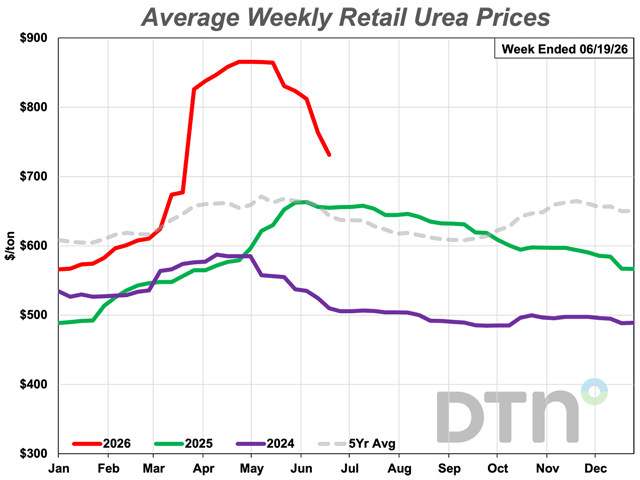
Urea during the third week of June was 12% less expensive than a month ago with an average price of $731/ton. (DTN chart)
OMAHA (DTN) — Retail fertilizer prices tracked by DTN for the third week of June 2026 show most nutrients are lower than last month. This is the second week in a row this has happened.
Six fertilizers were lower compared to last month while the remaining two were slightly higher. DTN designates a significant move as anything 5% or more.
Leading the nutrients lower were urea and UAN32. Urea was 12% less expensive with an average price of $731/ton while UAN32 was 7% lower compared to last month and had an average price of $544/ton.
The remaining four fertilizers were just slightly less expensive than a month ago. MAP had an average price of $910/ton, 10-34-0 $723/ton, anhydrous $1,091/ton and UAN28 $511/ton.
Two fertilizers were slightly more expensive compared to last month: DAP had an average price of $955/ton while potash is $494/ton.
On a price per pound of nitrogen basis, the average urea price was $0.79/lb.N, anhydrous $0.67/lb.N, UAN28 $0.91/lb.N and UAN32 $0.85/lb.N.
After the signing of a Memorandum of Understanding between the United States and Iran, the Strait of Hormuz is again reopened. The waterway moves significant volumes of fertilizer products and raw materials transit the region each year.
In The Fertilizer Institute (TFI) press release from June 18, TFI welcomed the reopening of the Strait of Hormuz.
“Roughly 40% of the world’s urea fertilizer and roughly half of it sulfur supply pass through the Strait of Hormuz, and so farmers in the U.S. and around the world need this vital shipping lane open and operational,” TFI President and CEO Corey Rosenbusch said. “We appreciate the diplomatic efforts that made this outcome possible and remain hopeful that continued stability in the region global will support agricultural supply chains.”
While the reopening of the Strait is positive news for global trade, agricultural markets and farmers around the world, TFI cautioned that market recovery from the disruptions will likely take months.
The reopening got off to a shaky start during the weekend on again/off again closures. Associated Press reported early June 23, “Tehran and Washington clashed over the Strait of Hormuz again this past weekend. Citing Israel’s latest attacks on Lebanon, Iran declared that it reclosed the strait. The U.S. was quick to contest that. Maritime tracking data showed that dozens of ships passed through on Saturday and Sunday, though far fewer than the daily average before the war.”
AP continued to add, “Data and analytics company Kpler said its tracking confirmed 131 ships traveled through the strait between Friday and Monday, including 39 crossings on Monday. In contrast, about 100 to 130 vessels a day made the journey before the U.S. and Israel launched strikes on Iran in late February, and Tehran responded with its own attacks and effective closure of the waterway.” (https://apnews.com/article/strait-hormuz-ships-crossing-iran-us-e6039e5f3962ba001ed6b7abb74219b0)
All eight fertilizers are now higher in price compared to one year earlier: Potash by 4%, 10-34-0 8%, UAN32 10%, urea 12%, DAP 13%, MAP 15%; UAN28 23% and anhydrous by 41%.
DTN gathers fertilizer price bids from agriculture retailers each week to compile the DTN Fertilizer Index. DTN first began reporting data in November 2008.
In addition to national averages, MyDTN subscribers can access the full DTN Fertilizer Index, which includes state averages, here: https://www.mydtn.com/agriculture/web/ag/markets/fuels-fertilizers#!/fertilizers.
The U.S. exported a record amount of urea to Canada in April of 2026, according to an article in worldfertilizer.com. You can read about it here: https://www.dtnpf.com/agriculture/web/ag/crops/article/2026/06/17/fertilizers-lower-first-time-since.
| Dry | ||||
| Date Range | DAP | MAP | POTASH | UREA |
| June 16-20 2025 | 807 | 833 | 474 | 655 |
| July 14-18 2025 | 811 | 847 | 481 | 654 |
| Aug 11-15 2025 | 825 | 895 | 484 | 642 |
| Sep 8-12 2025 | 862 | 917 | 488 | 631 |
| Oct 6-10 2025 | 921 | 922 | 485 | 601 |
| Nov 3-7 2025 | 926 | 930 | 489 | 597 |
| Dec 1-5 2025 | 916 | 921 | 489 | 586 |
| Dec 29-Jan 2 2026 | 847 | 876 | 484 | 566 |
| Jan 26-30 2026 | 851 | 866 | 485 | 583 |
| Feb 23-27 2026 | 853 | 880 | 486 | 611 |
| Mar 23-27 2026 | 857 | 906 | 489 | 826 |
| Apr 20-24 2026 | 901 | 939 | 492 | 866 |
| May 18-22 2026 | 912 | 953 | 494 | 831 |
| Jun 15-19 2026 | 910 | 955 | 494 | 731 |
| Liquid | ||||
| Date Range | 10-34-0 | ANHYD | UAN28 | UAN32 |
| June 16-20 2025 | 669 | 773 | 417 | 495 |
| July 14-18 2025 | 672 | 769 | 417 | 499 |
| Aug 11-15 2025 | 669 | 762 | 421 | 489 |
| Sep 8-12 2025 | 667 | 768 | 414 | 482 |
| Oct 6-10 2025 | 666 | 814 | 419 | 466 |
| Nov 3-7 2025 | 666 | 858 | 414 | 465 |
| Dec 1-5 2025 | 667 | 865 | 414 | 465 |
| Dec 29-Jan 2 2026 | 674 | 867 | 411 | 466 |
| Jan 26-30 2026 | 665 | 856 | 408 | 464 |
| Feb 23-27 2026 | 665 | 865 | 412 | 465 |
| Mar 23-27 2026 | 710 | 1035 | 484 | 558 |
| Apr 20-24 2026 | 722 | 1116 | 526 | 595 |
| May 18-22 2026 | 724 | 1118 | 531 | 586 |
| Jun 15-19 2026 | 723 | 1091 | 511 | 544 |
Russ Quinn can be reached at Russ.Quinn@dtn.com
Follow him on social platform X @RussQuinnDTN
(c) Copyright 2026 DTN, LLC. All rights reserved.