


The Race for the American-Made Drone
With new Chinese equipment banned, U.S. companies scramble for advantage.



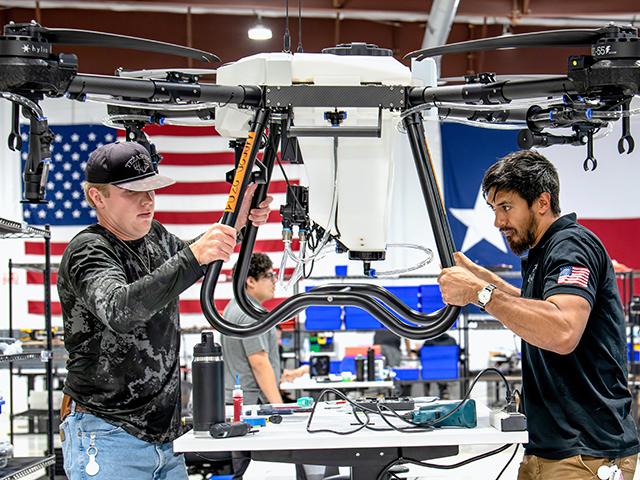
Hylio AgDrones embraces both its roots in Texas and in the United States. Its Houston-area plant can churn out 5,000 drones a year. (DTN/Progressive Farmer photo by Joel Reichenberger)
The future lies down a mile of crumbly blacktop on the farthest edge of the Houston metro area.
Go past the suburban chain restaurants and the gated neighborhoods to where manicured lawns start to give way to pastures.
Hang a right at The Flying Cow.
Maybe it’s hyperbole to say what awaits is the future. It’s a steel building that would look familiar to many a farmer, perfect for sheltering the combine. Instead, it shelters the manufacturing headquarters of Hylio AgDrones, an American aerial drone sprayer company.
The future of agriculture? A future of agriculture, perhaps, but one that has become evermore important through the last decade, as autonomous aerial drone spraying has crept along from theory to experiment to, in recent seasons, practical use in many parts of the country.
The burgeoning drone industry got a major jolt last December when the Federal Communications Commission (FCC) enacted a ban on the sales of new foreign-made drones. That decision rocked the pipeline that was launching thousands of Chinese-made drones into the Midwestern sky and further complicated a supply chain that was already dealing with hurdles in the form of tariffs and other import difficulties.
Frustrating for some, others see a window for which they’ve been waiting.
“We’ve been seeing this writing on the wall,” says Arthur Erickson, CEO and a cofounder of Hylio. “We’ve been ready.”
Aerial drone use has exploded in the U.S. ag sector in the last five years, but the ban on foreign equipment could usher in radical change for an industry still in its infancy. For the right players, it could mean a world of opportunity. The race is on to seize it.
“It’s created quite an interesting environment,” says Lukas Koch, a Kansas-based drone advocate and CEO of Kelly Hills Unmanned Systems. “This is the most exciting and opportunistic time ever for American drone companies.”
BUILDING A FUTURE
The dusty pastures around the Hylio drone manufacturing plant don’t scream high tech, but everything does inside the building, which is designed to pump out as many as 5,000 drones a year.
An assembly line runs down the middle of the facility, where many of the company’s roughly 40 employees transform the skeletal steel tubing of a drone into a robust machine powered by electric motors and capable of hauling — for Hylio’s Atlas drone, its largest — as much as 250 pounds of cargo.
There’s radar and lidar, spray nozzles and computer chips.
A separate production line runs along the back wall of the building, piecing together the 13.3-inch joystick-laden tablet computers used to control the machine. One large garage door is often rolled open for drone test flights. Once they’re proven airworthy, they’re carted to another room where large plywood boxes wait for shipment, fully stocked with an instruction binder and a Hylio ball cap.
The company is facing its big opportunity now, but it’s been preparing for the moment for more than a decade, since its founding as an idea kicked around by friends still then enrolled at The University of Texas at Austin. Erickson was just 22 years old.
“I could see the writing on the wall even when I was a young, dumb kid,” he says. “It was clear China was fast dominating the market, and we could see how powerful and revolutionary that technology was. So, we’ve known.”
Knowing is, as they say, only half the battle.
Drones aren’t exactly complicated, and a standard form has emerged — between four and eight propeller-equipped motors connected by tubes to a central area with a cargo tank and all the necessary computers, cameras and sensors. Many drones, whether built by American manufacturers or otherwise, follow those same rules and seem indistinguishable at a distance (and in some eyebrow-raising cases, up close, as well).
Simple enough, but building that machine and doing it without relying on imported elements has been nearly impossible.
SOURCING STRUGGLES
The December FCC ruling doesn’t require current users of foreign-made drones to stop using their machines or restrict the sale of previously approved drones. Citing threats to national security, it promises not to authorize any new foreign-made drones for use in the United States, and, surprising some in the industry, not to allow the use of many foreign components.
“Critical components, including data transmission devices, communications systems, flight controllers, ground control stations, controllers, navigation systems, batteries, smart batteries and motors produced in a foreign country could enable persistent surveillance, data exfiltration and destructive operations over U.S. territory,” the FCC document says.
Some components were easy to source through U.S. suppliers. Others have proven far more difficult, and none more so than motors and batteries.
“There’s really nobody else globally that’s producing motors that are as efficient and cost effective as China is right now,” says Kelley Wittenberg, national accounts manager at Central UAS Technologies, a company building ag drones out of Daytona Beach, Florida.
Central UAS was known as Leading Edge Aerial Technologies before it was acquired in late 2024. It’s been working with aerial drone sprayers since 2012 but initially focused first on mosquito spraying. It launched its first ag-focused sprayer drone, the PrecisionVision 100X, in September 2025 and followed up quickly. It announced the PV100X Pro in May, promising a larger tank, enhanced sensors and a better tech stack on drones shipping this fall.
The company goes to great lengths to source its materials in the United States. A 2023 ban in the state of Florida prohibiting using Chinese drones and components for use in state government work pushed the company to innovate. A headache then is paying off now.
“It’s tricky because 80% of the lithium in the world comes from China,” Wittenberg says. “It’s hard to get around that, so we have invested heavily in an American battery company so that we can get that ball rolling. We are also working with motor companies that are based in the United States to get to that point where we have an American alternative. Our engineers, at least half of them are veterans, so they’re passionate about it, and we’re passionate about it, as well.”
Hylio, too, is trying to work with American companies and announced a partnership with KULR Technology, another Houston-area tech startup, to focus on designing and building batteries appropriate for the mission.
Partnerships and sourcing are a critical strategic element for a young company, maybe even as important as the drone’s actual performance.
“Some drone companies have no problems finding compliant motors, and some really struggle,” says Koch, who’s served as an adviser for many early phase drone outfits. “It’s all about who you know. Some companies have decided just to build their own motor. This is all painful right now, but I think this is all very good in the long term. The companies that are working through it are seeing massive opportunity.”
FILLING THE GAP
Chinese manufacturers may account for as much as 90% of the U.S. aerial drone market as it stood in late 2025, and it’s not clear how soon they’ll fade away, if they even do.
Models introduced before December can be sold in the U.S., and many in the industry question to what degree some distributors will repackage or rebrand Chinese equipment as “assembled in the United States.”
No matter how that unfolds, there’s a quickly growing line of American companies vying for the chance to fill the gap.
Speaking last summer at a field day at Heinen Brothers Agra Services, in rural northeastern Kansas, Koch compared the growing drone market to the earliest days of tractors.
“By 1910, there were 156 tractor manufacturers in the United States,” Koch told the attendees. “Today, we’re having our tractor moment. Companies are doing it from their barns, and they’re building these systems. They’re coming out of the woodworks every day.”
The field day drew a large crowd — farmers and elected representatives, university researchers and drone company CEOs — all packed along a testing area to see the latest public demonstrations from many of the field’s most innovative companies. They saw a wide variety of aircraft, shattering the idea that drones need to look like the supposed standard form or be bound by perceived industrywide weaknesses.
A drone from SiFly, based in Silicon Valley, hovered over the field for three hours, demonstrating unparalleled endurance. Meanwhile, one from Pyka offered standout capacity as it buzzed a nearby corn field.
Pyka is more than three years into real-world use of its electric autonomous airplanes. Pyka’s Pelican 2 can carry up to 80 gallons, more than twice the payload of most quadcopter drones, and it has much greater endurance. It’s more akin to a small version of the common Air Tractor piloted sprayer aircraft but is hamstrung in some of the same ways, as it requires a runway.
“On the road map long term, three or four years down the road, is the design of a much larger airplane that actually competes with the full-blown Air Tractor,” says Volker Fabian, chief commercial officer at Pyka.
Other takes on the “bigger is better” line of thinking come from the company Rotor, which converts full-sized helicopters into autonomous drone sprayers, and Surgeon Drone, based in Louisiana, which is working to find a more robust version of the quadcopter concept. The company hopes to use an onboard gas generator to power electric motors that can ultimately hoist as much as 250 pounds.
Then, there are some potential players who haven’t shown their cards yet, companies like John Deere, AGCO and Case IH.
Deere showcased green-painted drones in the past as a part of a futuristic concept, including at the 2019 AgriTechnica show, in Hanover, Germany, but none of the major ag machinery manufacturers have brought anything to market.
They may not, industry advocate Will Dawson says, until the dust starts to settle.
“They’re doing what I call the Facebook approach,” says Dawson, who heads up the Agriculture Drone Initiative, an industry lobbying group working in Washington, D.C. “They’re doing a lot. Everyone gets a call. Everyone’s getting an exam, and I think they’re waiting because it’s a heck of a lot easier for them to let investors waste their money, and they just want to pick a winner.”
DELIVERING THE GOODS
Koch can rattle off 15 American companies at various stages of development with their drones, and that doesn’t count those companies that have yet to go public with plans.
There could eventually be dozens, by his estimate, and many could find some ability to stick around.
“Less than 2.5% of farmers own an ag drone, so that means 97.5% are still waiting,” Koch explains. “The opportunity exists.”
The dream has already died for some, including well-funded efforts. Guardian Agriculture, based outside of Boston, pulled in more than $50 million in investment and built the massive SC1 drone. It came with a claim it could cover 40 acres an hour thanks to fast-charging batteries.
Yet, the company announced in September it was permanently grounded.
And, no matter what presence Chinese drones have going forward, American companies are cognizant they’ll need to be able to compete with the best equipment in the world.
“The perception that’s out there, because it’s been true, is American drones have not been winning on technology,” Central UAS’s Wittenberg says. “They haven’t been winning on affordability, and they really haven’t been winning on service and support. So, with the PV100X Pro, we really want to win on technology. We’re going to win on service and support. The price differential has dropped dramatically. It’s gotten much closer, and now that Chinese drones are not allowed in the country, that technology gap is going to make it so you can say, ‘Chinese drones are cheap, but an American drone is better.'”
From Michigan to Texas, from the East Coast to the West Coast, companies are chasing that same plan: Take advantage of this lull in Chinese drones to build competitive, and eventually, superior products.
That’s the goal down that crumbly blacktop road outside of Houston, close to The Flying Cow, a burger shack tucked into an RV park. It actually shares something in common with its neighbor, as it, too, is a steel building that may look more at home sheltering farm machinery.
Inside, The Flying Cow, too, seems positively space-age as a robot rolls along the concrete floor to deliver food to diners.
Across the street at Hylio — and around the country — more than a dozen companies are vying to seize the moment, hoping to deliver a lot more than cheeseburgers and milkshakes.
**
— Follow Joel on social platform X @JReichPF
[PF_061026]
(c) Copyright 2026 DTN, LLC. All rights reserved.