


Gulke: Pre/Post WASDE
The views expressed are those of the individual author and not necessarily those of DTN, its management or employees.



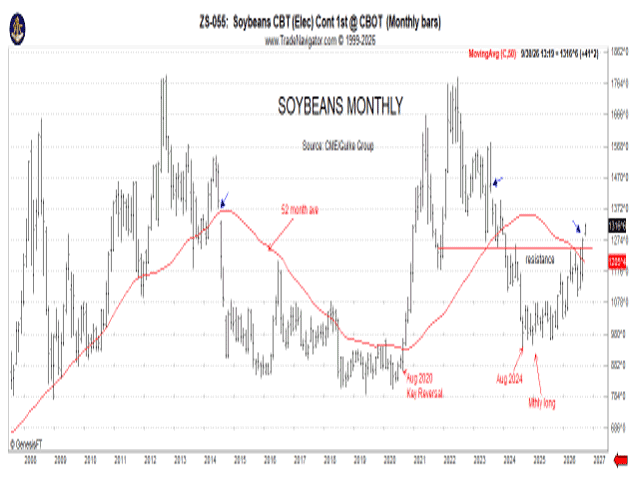
(Chart by Gulke Group)
The August WASDE was widely anticipated as a non-event — a ho-hum report, as is usually the case. I suggested there would likely be a surprise significant enough to warrant buying short-term put options, call options or both. At-the-money corn and soybean options were about 8 cents and 12 cents, respectively. Since that report, corn is up 37 cents and soybeans are up 38 cents. For those who were bullish, as I was, the return on investment was terrific — especially if they heeded the advice of media analysts to sell every nickel higher. Those analysts’ puts became worthless, and anyone who had a crop hedge in 2026 had or has a margin call.
I have argued for years — and will continue to do so — that technical analysis will signal market direction well before markets make a move up or down. I proved that to myself decades ago, and it has served me and those I have worked with very well. While technical analysis isn’t for everyone — and even I find it hard to believe sometimes — it does prevent the kind of big mistake that would have a significant influence on taxable income.
The key is knowing when to accept market risk (holding off on selling in anticipation of better opportunities). Conversely, and perhaps even more important, is knowing when to pass off risk (selling to someone else), as markets often spend more time going down than up. It pays to have a reliable price outlook — one that accounts not only for the fundamental value of a commodity but also for overall market psychology. Both influence money flow in or out of a commodity. Concentrating on cost rather than maximizing gross profit is folly. The market doesn’t care about your personal cost of production. It cares about relative value — what a commodity is worth to the buyer — and the fundamentals of supply and demand.
Supply and demand fundamentals dictate that when demand exceeds supply, prices need to rally to discourage usage — a dynamic often called price rationing. The extent of a price rally is often influenced by a commodity’s price inelasticity (where demand persists regardless of price) or elasticity (where buyers are willing to find a substitute). Conversely, when supply exceeds demand, prices will gravitate lower to encourage demand or discourage production, or both.
The 20-year soybean chart shows significant price volatility — opportunities to profit from price appreciation, do nothing or be subject to price deterioration below the cost of production. I have used the phrase “deer in the headlights” to describe brokers and analysts who, in my view, didn’t see a bull market developing — as in August 2024 — and who wouldn’t recognize the end of a bull market until it was in their rearview mirror. The monthly soybean chart accompanying this column shows key price events that served as important indicators and helped mitigate risk. The August price action and monthly gaps and reversals come to mind. (See blue arrows on chart.)
Note the significance of August over time. Soybeans posted major August price events in 2020 and again in 2024, along with notable price gaps.
When prices gap higher on a monthly basis, it tells me that the market has fundamentally changed and a new price outlook has begun. This technical signal often leads the fundamentals that eventually come to light — and are often credited for the market move — doing so well before those fundamentals are widely known and traders begin to pay attention.
While soybean prices have been in a monthly uptrend since August 2024 and have rallied significantly, recent price action — specifically a monthly gap higher — suggests we are sailing in marketing waters not seen in years. That will hold true until something changes, such as a market top or that monthly September up-gap getting filled. Up-gaps tend to get filled in a relatively short time; down-gaps may take considerably longer.
The post-WASDE market reaction will likely be as important as — or more important than — the WASDE report itself. So much analysis has been offered since the August WASDE that there seem to be good odds this report will be a non-event. But I wouldn’t bet the farm on it. It all depends on where NASS analysts land — in what field and what part of the field — as variability is the word on many farmers’ lips. I won’t be surprised by anything.
Preparing for this report isn’t as straightforward. October at-the-money corn calls (priced off December futures) are about 11 to 12 cents. At-the-money soybean puts and calls cost about 21 cents each. In both cases, it costs roughly twice as much to manage WASDE risk as it did last month. The easy money appears to be gone — but the monthly gap higher is worth noting on the chart. Someone was willing to pay more for soybeans this month than at any point since January 2024.
The question to ask is this: Why would anyone in their right mind do so after the price ship has already sailed to beans in the teens? I have my ideas, but hopefully the latest WASDE report will give us a clue.
Jerry Gulke can be reached at (707) 365-0601 or by email at Jerry@gulkegroup.com
(c) Copyright 2026 DTN, LLC. All rights reserved.