


Gulke: Energy
The views expressed are those of the individual author and not necessarily those of DTN, its management or employees.



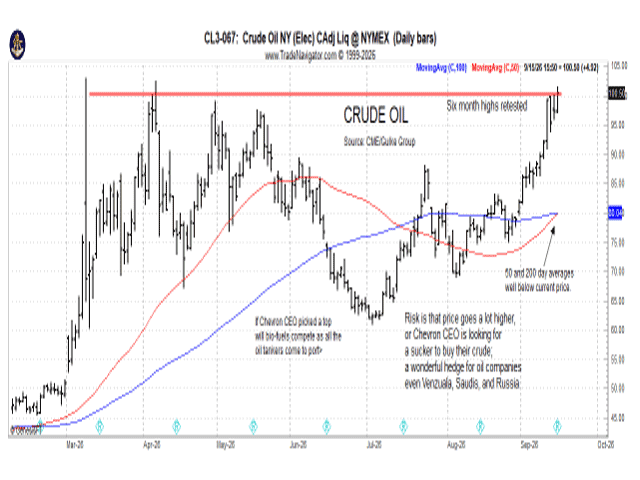
(Chart by Gulke Group)
There have been comments for months in the media regarding the cost of inputs that go into producing a crop, especially fertilizer and energy. The future looks more questionable than it did just eight months ago, as the wars seem to be escalating.
Jan. 8, 2026, was a key date in the price of energy. On that day, the rack price for off-road farm diesel (2,000-gallon semi-loads) was about $2.02 to $2.05 per gallon. We advised getting some or all fuel needs through spring locked in, if possible, in the cash market. Some bought even more, covering the planting and harvest seasons. Some did nothing and purchased hand-to-mouth for whatever reason. A price anywhere close to $2.50 per gallon in 500-gallon increments made sense. For those who did not buy in 500-gallon increments, troubles only got worse over time.
Currently, off-road B20 diesel is about $5.50 per gallon, including a 30-cent increase Monday and another 25 cents Tuesday. Figuring 6 to 8 gallons per acre to produce and harvest a crop, that is about an $18 to $20 per acre increase in the past nine months. December corn futures have risen about 90 cents since the January low. If no fuel was purchased in January, the gross income on corn at 180 bushels per acre has increased about $162 per acre, more than offsetting the energy increase by a factor of 10.
Let’s say you took the advice from media analysts and sold something every nickel and dime higher on 40% to 50% of your 2026 production, or about $80 per acre more gross than nine months ago. If you had corn in the bin, as some suggested a large percentage of producers did in 2026 (someone is holding that 1.9-billion-bushel carryover), even better. You were right, and the negative media moguls were wrong. Producers probably outsmarted the “buy puts and put a floor under the market” advisers, including bankers who also were looking backward to predict the future or protect their working-capital loan positions. That is in the past, and we have another ox to gore next year.
CHEVRON CEO ISSUES A WARNING
Over the past few months, Chevron’s CEO reportedly said the oil industry had ways to mitigate the impacts of an oil shortage. Now, he warns, those options are running out.
“All these mechanisms helped to mitigate the price and supply risk,” Chevron CEO Mike Wirth said Friday at an energy conference in Austin, Texas, according to The Wall Street Journal. “Those have largely now played out, and we don’t have nearly the buffers in the system that we did when it began.” He warned that he does not foresee oil prices going back down anytime soon, which will mean higher fuel prices at the pump. “I wish I could tell you that I saw some reason why things would ease, but it’s difficult right now to see that happen,” he said.
The Chevron CEO’s comments are typical of what we often hear after the price ship has sailed. Usually, I would say that if a CEO comes on TV with a warning at high price levels, and/or The Wall Street Journal prints it, the news is already old, and the top may be near. This is similar to what happened at the most recent top, when two popular personalities were on TV excited about the prospects of the bull market, and prices have retreated ever since, so far. Check out the crude oil chart accompanying this column. It speaks volumes.
But what if the CEO is right? With war tensions increasing on expanding fronts and the president seemingly in over his head in the war effort, prices could rise further. Even a blowoff top could scare everyone. It is much more difficult to manage $5.50 diesel now than it was to manage $2.05 diesel nine months ago.
Here is an idea if it falls within your risk tolerance. If not, look back at the last nine months of doing nothing.
Stats: A 42-gallon barrel of crude oil yields about 19 to 20 gallons of gasoline, 11 to 13 gallons of diesel fuel and 3 to 5 gallons of byproducts used for roads and other purposes. One mini contract equals 500 barrels, or roughly 10,000 gallons of gasoline and 5,000 gallons of diesel fuel. The margin requirement for one mini contract is $5,000.
There are smaller contracts for starters. One micro contract (ticker symbol QT) equals 100 barrels, or about 2,000 gallons of gasoline and 1,000 gallons of diesel fuel.
If you wanted to cover 3,000 gallons of diesel, you could use a micro contract and get reasonably close. A mini contract is more applicable to larger producers. On Monday, for example, when crude oil was up $4.40 per barrel, diesel was up 25 cents and gasoline was up 11 cents, or roughly 2-to-1.
Given my analysis of energy, similar to the approach I used to manage grains in 2026, I will watch the price action of crude oil, heating oil (a diesel comparison) and RBOB gasoline and advise accordingly. To do otherwise is to ignore the situation.
E85 ANALYSIS
Four weeks ago, I bought E85 for my truck at $2.64 per gallon, while E10 was $4.04. Five days ago, E85 was $3.24 while E10 was $4.24. With only about a 12% reduction in miles per gallon, E85 remains a bargain.
Doing the math, $3.24 multiplied by 1.12 equals $3.62 versus $4.24 for E10. That’s a difference of 62 cents per gallon. Multiply that by a 25-gallon tank, and the savings are about $15.50 per fill-up. For someone filling up weekly, that adds up quickly. That buys a lot of groceries over a month. Maybe President Trump is right that affordability is a hoax? Why the ethanol and corn grower associations are hollering from the hilltops regarding E85 is beyond me.
I guess sensationalism sells, but it doesn’t pay the bills.
If you’re interested in learning more about the advantages of risk-management tools and how I (we) use them to manage price risk, call 707-365-0601 or email Jerry@gulkegroup.com.
(c) Copyright 2026 DTN, LLC. All rights reserved.