


Gulke: A Top or a Pause?
The views expressed are those of the individual author and not necessarily those of DTN, its management or employees.



(Charts by Gulke Group)
There is one more chance for a bullish report on Wednesday, but I doubt it will happen.
The results of the Xi-Trump Board of Trade meeting were about what I expected, for reasons I outlined in last week’s column. Managing risk last week included mentioning the cheap put options available for corn, soybeans and wheat for those who needed them. Given the sell signals that emerged in the Sept. 9-11 market, including daily key reversals in soybeans and wheat and wide trading ranges that coincided with other private analysis, I recommended increasing coverage for 2026 and 2027 to roughly 85% to 90% through a combination of cash sales and futures positions in corn, soybeans and wheat. Adding cheap put option coverage for 5 to 8 cents simply increases coverage further while keeping risk defined.
The new Xi-Trump meeting fact sheet validated my suspicions, while many in the media seemed surprised by the results.
There were other signals suggesting a pause, if not a top, in the grain markets. Tariffs, negotiations and China-U.S. trade agreements had likely run their course for agriculture, as President Donald Trump did what he said he would do for agriculture by stimulating prices through whatever means were available. If agriculture cannot be profitable at recent prices, I felt there was not much the government could do heading into harvest. Conditions may get worse before they get better unless weather becomes a factor here or in South America.
I felt it was important to keep my options open heading into harvest as we learn more from Wednesday’s stocks reports.
Prices have dropped significantly since Sept. 11, and harvest will finally begin in earnest after the next weather event, which could drop 2 to 4 inches of rain in places. Following that, a seven- to 10-day, or longer, harvest window should develop.
There has been considerable concern regarding high fuel costs, which I estimate have increased expenses on the farm by about $15 to $18 per acre. It is interesting that among the various soybean and corn associations, as well as the print and broadcast media, there has not been a word spoken since Sept. 11 about the fact that price declines in corn and soybeans have exceeded the entire increase in fuel costs that ag cooperatives and others have been highlighting.
Corn, for example, is worth $47 per acre less now.
Obviously, the media is majoring in minors again, as the focus on marketing gets lost in the fray. Negative news sells, I guess.
The key question Wednesday centers on corn feed and residual use, which some observers have felt for more than a year has been overly optimistic given the size of the livestock industry. If that figure is left unchanged or only modestly altered, USDA-NASS will have the opportunity to lower corn yields and feed and residual use enough to keep the balance sheet snug without overdoing it.
The October WASDE report will carry significant weight, as it will reevaluate supply and demand along with the all-important corn and soybean yield estimates. By then, we will also be in the heart of harvest and have real-world producer results to compare against USDA’s assessments.
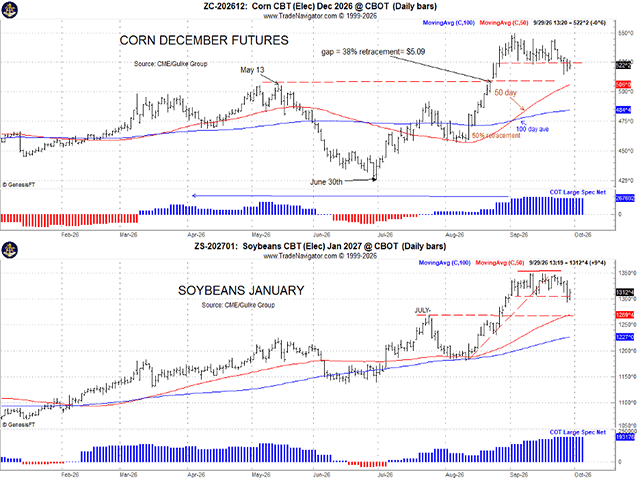
The corn and soybean charts accompanying this week’s column reflect price discovery at work.
A few points to ponder as we head into Wednesday’s reports:
CORN
Corn broke out of a sideways trading pattern as new information entered the market and price discovery continued. The 50-day and 100-day moving averages remain some distance away. Large speculators have maintained a long position since late July and continue to wait for higher prices.
SOYBEANS
Soybeans have attempted to break down but have not succeeded, making Wednesday’s reports critical. The 50-day moving average sits near the all-important May 13 high and must hold. Large speculators have been extremely long since Jan. 2.
LARGE SPECULATOR POSITION
Many newcomers to the risk management business seem unaware that large speculators can hold positions much longer than the capital behind a trader’s hedge account can withstand. Large speculators are opportunists, and they will begin selling long positions just as the pessimists finally get bullish religion.
I believe there are two harvests: the traditional harvest and the large-speculator harvest.
If the large speculator is right about this position, we could be in for an interesting ride. If the large speculator is wrong and gets blindsided by the October WASDE report, Katie bar the door.
(c) Copyright 2026 DTN, LLC. All rights reserved.