


Gulke: Taking Responsibility
The views expressed are those of the individual author and not necessarily those of DTN, its management or employees.



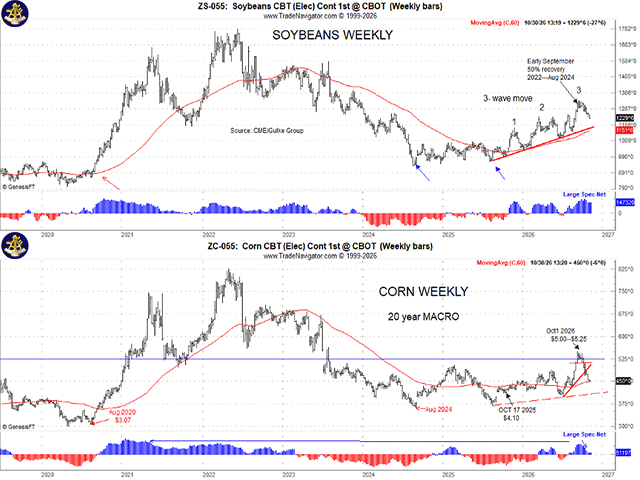
(Charts by Gulke Group)
It may seem like a broken record, discussing the price action over the last 10 months. Given the demise of pricing opportunities to the point where the major commodities of corn, wheat and soybeans have come, or are in the process of coming, full circle again, it is worth reviewing the past so we don’t repeat the same mistakes going forward.
I have to go back to my repeated scenario of over two years ago, when I suggested we were in a bull market that was unrecognizable at its beginning. I have repeated that view ever since. You’ve heard all the rhetoric about increased costs and the economic difficulties of production agriculture.
Most recently, a popular media analyst said that prices normally fall during harvest, and the recent demise was just that: harvest pressure. Yet, as the weekly soybean chart accompanying this week’s column shows, during the past two years, soybeans bottomed in August before harvest and rose in price into late August and September 2026, when prices topped. Ironically, that was a similar period when prices had risen right into harvest. Those price watchers got it wrong big time, turning bullish right at the top. How soon they forget.
The final thrust of an often-typical three-wave move higher in a bull market began June 30 and ended with move No. 3. This was about the time Pro Farmer came up with its estimates, and the media grabbed ahold of them, suggesting higher prices amid an acreage battle that was surely going to take place next spring.
In addition, wave three coincided with the great disappointment that the Trump-Xi meeting didn’t culminate in more soybean commitments and maybe some corn sales to boot. The fact is, the meeting was never about adding more to an already existing plan; it was more of a progress report and verification of actions taken. There was nothing to complain about with China, as it was living up to its initial and subsequent agreements, which included a 25 million metric ton purchase of soybeans. There was nothing in the May agreement for corn in the first place. Those analysts were wrong, and producers lost income as a result.
Also, regarding the large spec involvement, there was report after report cautioning against the idea that “the spec will have to sell sometime, and when he does, the door won’t be big enough to let him out!” Yet, the majority of media advisories got bullish at the top of wave three. See the accompanying soybean chart for red/blue spec positions and arrows depicting the August bottoms.
For corn, the protocol for catching the majority long and wrong was, and is, similar to the soybean discussion above.
Note that the large spec position maxed out at a magnitude similar to 2021 and 2022, yet there was not one public warning. Rather, major observations were that corn had to get to $6.50-$7 per bushel to ration demand. Not so, as we are now $2-$2.50 per bushel below those targets and more than a dollar below the Sept. 2 top, or about $200 per acre in lost income due to irrational exuberance by the well-intentioned, late-to-the-party bulls!
Corn has now retraced nearly 100% of its gain from June 30, meaning the price must increase nearly 25% from today’s value just to get back even. What do you think is out there to make that happen?
Corn also has August bottoms going back to 2020, when it hit $3.07, that are obvious to Foxy, my grandson. Yet there has not been a word about such an occurrence outside this column. Quite the opposite: Those bullish $7 calls came right at the top and at a time of year when prices have bottomed in the past before the two-year bull market, fooling the best in the business.
The problem is that the best in the business don’t have skin in the game and have little, if any, understanding of the workings of a producer’s mind. Sometimes a blunt comment, while considered politically incorrect by some on social media, has to be stated to get a point across.
There is a saying: “The road to hell is paved with good intentions.” I have no doubt there were good intentions over the last 10 months, but to concentrate on the cost of fuel while ignoring three pricing opportunities created by the market’s appreciation is almost unforgivable. We all make mistakes, but the key is not to make BIG ones. Keep them small and manageable.
As long as I am being politically incorrect, I have come to the conclusion that there are some who have evolved in the business whose observations have done more to hurt ag finances than help.
BOTTOM LINE
We have seen a demise in ag prices in the last 60 days that will likely take a long while to recover, short of a disaster in South America in the next 90 days or one in the U.S. next summer. I farm each year with the plan to produce the best crop in my history, and that often doesn’t come to pass. But all the while, the main focus is to maximize gross income, something that was grossly ignored.
It is highly likely that the last 40% or more of this year’s corn production will be sold well below the cost of production. There has to be an education in this experience!
Study the price charts until a virtual boxing glove pops out of the screen to make a point. If there is a learning curve in agricultural profitability, it came again this year.
(c) Copyright 2026 DTN, LLC. All rights reserved.