


Gulke: Reader Response
The views expressed are those of the individual author and not necessarily those of DTN, its management or employees.



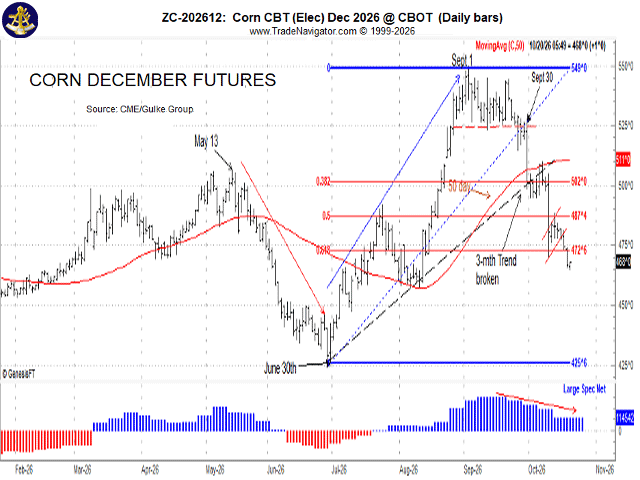
(Chart by Gulke Group)
Responses to my marketing columns are appreciated, whether pro or con. There is a view that if someone takes the time to respond, there are probably tens, if not hundreds, of others who have the same or similar question(s) but don’t take the time to respond. The following is a narrative of questions and responses that are likely of interest to readers.
Q: Jerry, how competitive do we have to be when corn in the EU and China is well over $8 per bushel and Brazil corn is well over $1 per bushel higher than we are? If we’re not competitive, who made it that way?
A: Adding in shipping costs, U.S. corn is about equal in price to domestic EU corn. As you know, the EU currently needs corn because of its domestic crops. With that being said, the EU is buying U.S. corn at a much higher rate than normal.
China is different. It has an additional tax on corn imported from the U.S. It also has a price difference for corn bought under or over its yearly quota. This makes it difficult to compete for China’s business versus South America. Hopefully, that extra tax will be removed in negotiations, but that still does not mean China will buy from the U.S., even if prices are competitive with those of other countries.
Q: I bet if we sent the USDA over to these other countries, they could “find” more bushels just like they do here.
A: Look at some of the USDA NASS numbers for international production compared to those countries’ own equivalents of USDA estimates, and you might change your mind.
Q: Only the USDA can lower crop ratings in Nebraska by 9% on Monday, then on Friday raise its yield by 11 bpa. They say one thing one day and the complete opposite the next.
A: It is somewhat data-driven, but I agree that the system is flawed in many ways. Seth Meyers has a good analysis of the Nebraska numbers if you care to look it up. The way I see it, there were statistical errors going back to September that may have had Nebraska too low. I do not think the corn crop is as large as USDA projected this month, and with more harvest data, let’s see what they say in November. I do not think the drop will be as much as we all think it should be.
Q: I’m sure the crop insurance price that’s being set in October was just a coincidence to keep prices lower, right?
A: With a spring price of $4.62 and the current harvest price average of $4.91, the insurance price will reset to $4.91. When the harvest price is higher than the spring price, your insurance policy essentially becomes a yield policy. Even if the crop isn’t as big as USDA reports, I find it hard to believe that many farmers will have corn claims this year. The ECO County program may pay out since it has a much lower deductible.
Q: What a corrupt, inept agency we have. Like I’ve said before, they make up numbers to fit their narrative.
A: All walks of life have created scenarios to fit a narrative since the beginning of time. Some navigate those waters, and others do not. The markets have given us great opportunities this year to make good money despite the USDA. I sincerely hope you prospered.
The recent October WASDE report set off a firestorm of disbelief on social media. But, in fact, prices peaked shortly after the Pro Farmer Crop Tour and, coincidentally, when social media and analysts were full of expectations for $6.50 and even $7 corn.
Price analysis indicated a top on Sept. 1, well ahead of the September Stocks report or the October WASDE. Note that subsequent price action broke below the September trading range and the three-month uptrend. Large-spec net-long positions reached historic highs, and prices have now fully retraced 62% of the gain from June 30 to Sept. 1, a move of $1.25 per bushel, or about $225 per acre.
I mentioned two years ago that the bull market wouldn’t be recognized by the media, and in columns this spring and summer, I suggested the end of the bull market likewise would not be recognized until it was seen in the rearview mirror. A lack of rational outlook may have cost our industry billions in opportunities that were gained and then evaporated, not only in corn but in wheat as well, which also topped on Sept. 1.
The top on Sept. 1 was just the opposite of what occurred during the previous two years, catching the trade leaning in the wrong direction. Will a complete reset in soybeans be in our future as well, or will the trade miss the next trend?
(c) Copyright 2026 DTN, LLC. All rights reserved.