


Gulke: Election Fallout
The views expressed are those of the individual author and not necessarily those of DTN, its management or employees.



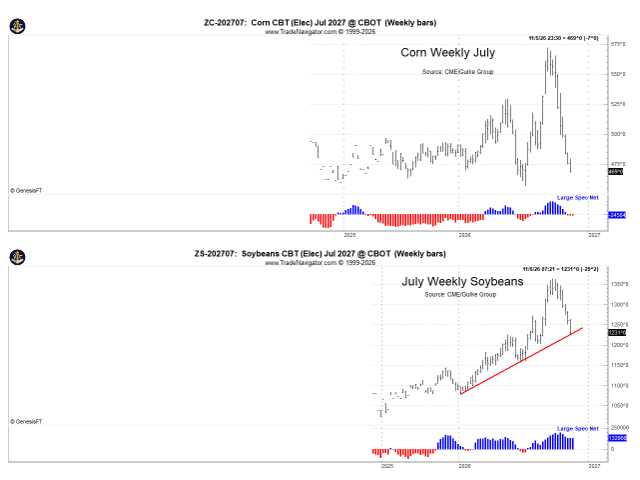
(Charts by Gulke Group)
What impact last night’s significant change will have on ag profitability remains to be seen. This won’t be my first rodeo. I have successfully navigated the political waters of both parties over the decades, confident that, given stated ag policies, I can successfully weave my way through any roadblocks and come out on top.
Last week’s column ended with the following bottom-line summary: “We have seen a demise in ag prices in the last 60 days that will likely take a long while to recover short of a disaster in South America in the next 90 days or one in the U.S. next summer. It is highly likely that the last 40% or more of this year’s corn production will be sold well below cost of production.”
This week, I chose to accentuate that statement with weekly July corn and soybean futures price charts dating back to their inception nearly two years ago, when they became available for trading. The price ranges are graphic and present some concerns about where price action could take the long-term outlook.
CORN
Corn has retraced all the gains made in 2026 and threatens to retest the June 30 low. To regain those losses and challenge the highs again will require nearly a 20% gain in price by the time July becomes the lead contract. This begs the question: What is in the market that could again create such a bull market? Put another way, we’ll need a $200-per-acre increase just to get us back to the opportunity we had two months ago.
SOYBEANS
Soybeans have not reacted as negatively as corn and are currently testing their longer-term uptrend. While a dollar lower than their Sept. 1 top, they are still $1.50 higher than on Jan. 2. The question remains: Does the price of soybeans need to give back all of its 2026 gains to maintain necessary demand, or is there sufficient demand to keep stocks tight and respect the uptrend? The next WASDE will be a determining factor.
CHICAGO WHEAT
Incidentally, wheat has already violated numerous support levels and uptrends and is $2 below its Sept. 1 top but a dollar higher than the price posted Jan. 2. In fact, all classes of wheat have collapsed, while large speculators never did get net long, even during the two-year rally.
ELECTION IMPACT
How markets perform postelection and what the major statement made by voters means are yet to be determined. The concerns are outlined above, suggesting we have to get through the November WASDE before we have any hope of something changing the psychology of the market.
Market psychology is not given the credit it deserves. It is a culmination of global traders assessing a myriad of fundamentals and is a very important part of the price-discovery process, be it a rising market like the one we had for two years or the collapse of the past two months.
WHAT TO DO
The easy money from hedging is gone in corn and wheat; soybeans are at a crossroads. If soybeans hold the uptrend, there will be a lot of beans planted in 2027.
If you acted on previous column thoughts and are 60%-70% sold, a $4.50 corn call option is about 4 cents and has a life of about 16 days, well past next week’s WASDE and into the Thanksgiving holiday, when trends have a tendency to change, strengthen or even accelerate. If you are woefully unsold and lack storage, those call options are much cheaper than commercial storage.
For soybeans, January $12 put and call options are about 23 to 28 cents and are good for 50 days, well past the WASDE and providing time to further confirm production in Brazil.
PERSONAL IMPACT
The clients I serve and I are well sold in both corn and soybeans, with more than 60% sold for cash, and have also benefited from the volatility opportunities during 2026. In the short run, should prices go up or down 30 cents in corn and another dollar in soybeans, the net effect on total crop gross income is rather negligible in the whole scheme of things and won’t change the overall year’s result all that much.
I’d rather let the market decide first, giving us an indication of the election’s impact and, of course, what next week’s WASDE has to say.
I have more concern about the 2027 crop and USDA’s seemingly optimistic demand. I suspect the market has concerns as well. Market action, as seen in the price charts, increases my concern that the highs posted Sept. 1 will hold for some time to come, affecting my long-term outlook.
There will be opportunities, of course, but the easy money is gone.
(c) Copyright 2026 DTN, LLC. All rights reserved.